What is the 1-2-1-1 press defense in basketball?
The 1-2-1-1 press defense, also known as the diamond press, is a basketball defensive strategy that features full court pressure and a sideline trap, particularly in the backcourt, which could lead to limited scoring opportunities as well as possible turnovers for the offensive team.
How to comprehend the player roles and diagrams on this page
In reference to any diagrams below, each of the offensive and defensive players are typically represented by the standard basketball positions, unless otherwise noted.
Moreover, offensive players are signified by numbers such as 1-5 while defensive players are indicated by the letter X, which is then followed by numbers such as X1-X5.
In essence, 1 and X1 indicate the respective offensive and defensive point guards. 2 and X2 signify the respective offensive and defensive shooting guards.
3 and X3 denote the respective offensive and defensive small forwards. 4 and X4 designate the respective offensive and defensive power forwards.
5 and X5 represent the respective offensive and defensive centers.
Moreover, in terms of a brief legend for the diagrams:
- Black Dot or Small Circle: The black dot or small circle represents the basketball.
- Solid Arrow: The solid arrow indicates movement or a cut on the basketball court.
- Dotted Arrow: The dotted arrow denotes a basketball pass.
- Wavy Arrow: The wavy arrow indicates dribbling.
- T-Shaped Symbol: The T-shaped symbol signifies a screen, also known as a pick.
- Double pipe symbol: The double pipe symbol represents handoff action.
What is an example of the initial formation for the 1-2-1-1 press defense?
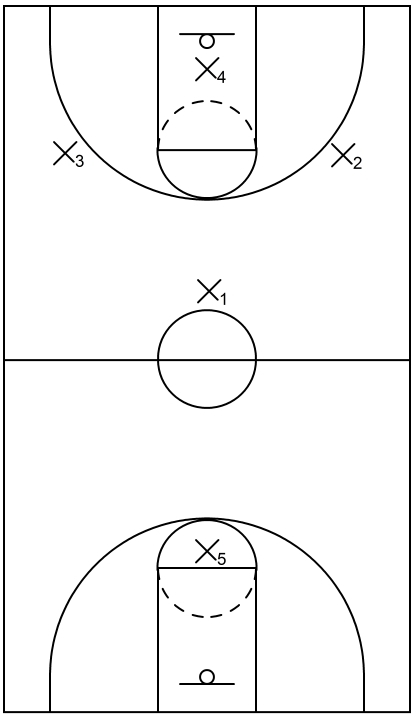
In terms of the initial formation for the 1-2-1-1 press defense, X4 starts near the backcourt basket inside of the lane area. X3 and X2 start near the wing areas adjacent to the three-point line.
X1 starts near the half court line just below the center circle. Lastly, X5 starts near the high post area on the opposite side of the floor in the frontcourt.
It should also be noted that the four backcourt defenders create a diamond alignment, hence the alternative name known as the diamond press.
In relation to the general responsibilities for the defenders, X4 influences the offensive player in possession of the ball towards the sideline, which could lead to defensive traps.
The responsibilities of X2 and X3 are to trap the ball near the sideline or intercept any passes towards the middle of the press.
The responsibilities of X1 are to cover the middle area or intercept any passes towards the frontcourt near the sideline. The responsibilities of X5 are to cover the back of the press in the frontcourt or drop down to protect the basket if necessary.
What is an example of the 1-2-1-1 press defense when the ball is initially in the backcourt?
When the ball is in the backcourt, one defender can influence the offensive player in possession of it towards a sideline while another defender nearby brings additional pressure, ready to set a trap as well.
The example diagram below demonstrates this concept.
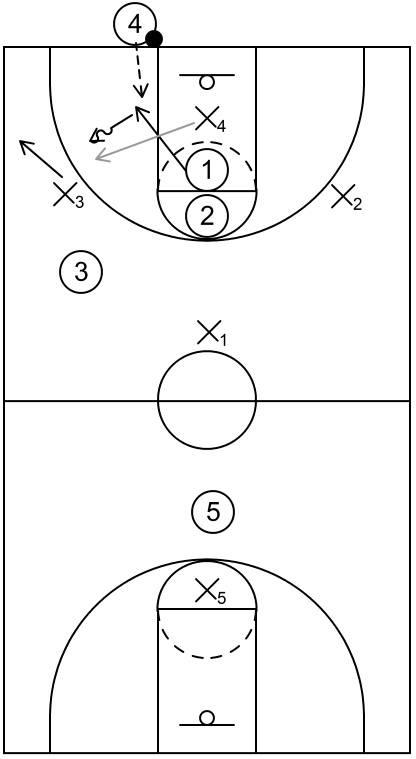
To start, 1 receives the inbound pass from 4 and when that happens, X4 immediately brings defensive pressure while influencing 1 into dribbling towards the sideline, represented by the gray arrow.
As that happens, X3 steps up to provide more defensive pressure alongside X4.
What is an example of the 1-2-1-1 press defense that shows the ball being trapped?
When the ball gets pushed towards a sideline in the backcourt, two particular defenders can implement a trap to cause potential turnovers.
The example diagram illustrates this point in more detail.
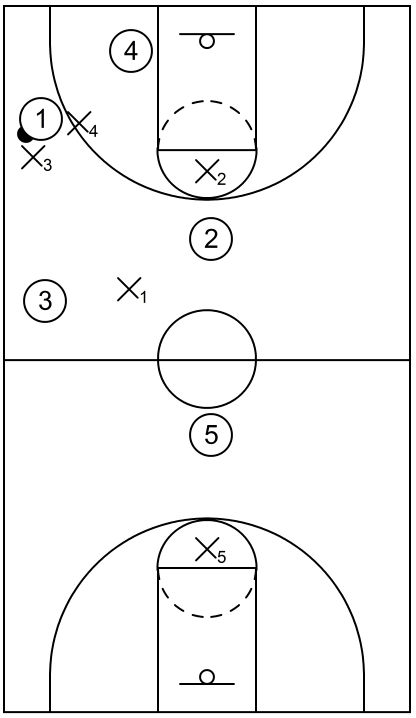
To begin, X3 and X4 set the trap and as that occurs, X2 cuts over to the middle area near the high post area.
This allows X2 to intercept a potential pass towards the middle of the press. Furthermore, at the same time, X1 slides over a few feet to split the difference between offensive players 2 and 3. This also allows X1 to get an interception if 3 were to receive the ball from 1.
In the frontcourt, X5 stays in position near the high post area. Additionally, as an alternative option, it is possible to play even more aggressively in the frontcourt by allowing X5 to move up above the three-point line as another possible interceptor.
However, it should be noted that the other defenders would most likely not be able to get back in time to protect the basket from this vantage point if X5 misses the interception opportunity.
What is an example of the 1-2-1-1 press defense that shows the ball being intercepted near the middle?
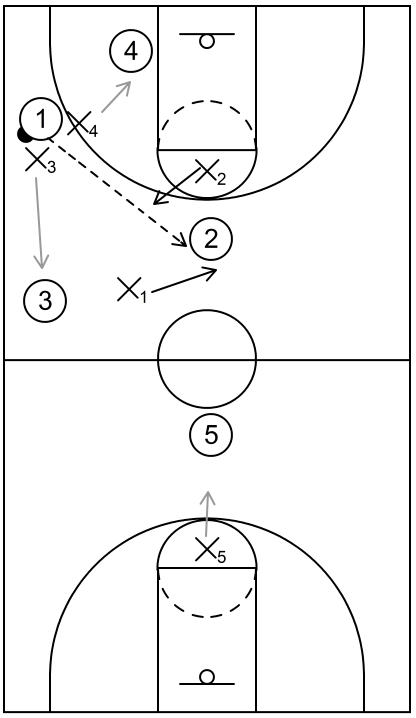
When an offensive player gets trapped and throws the ball towards a teammate in the middle of the press, it’s possible for an off-ball defender nearby to intercept that pass, resulting in a turnover.
The example diagram below demonstrates this concept.
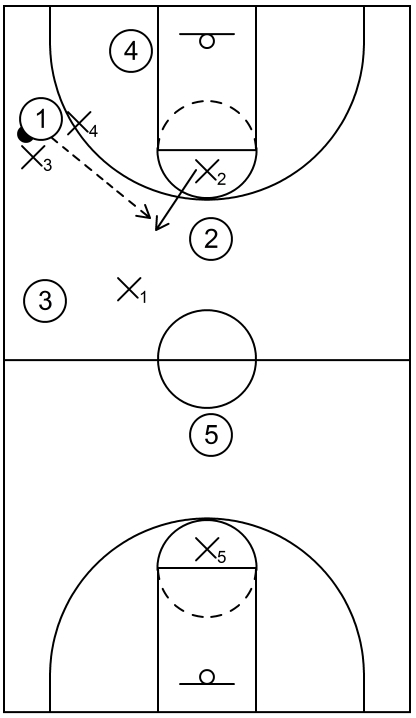
Essentially, 1 gets trapped by X3 and X4 so 2 is the recipient of the pass from 1. However, X2 steps into the passing lane and intercepts the pass producing a live-ball turnover.
What is an example of the 1-2-1-1 press defense that shows the ball being intercepted near the sideline?
When an offensive player is being trapped and throws the ball towards a teammate near the adjacent sideline closest to the frontcourt, a off-ball defender nearby could intercept that pass.
The example diagram below showcases this in more detail.
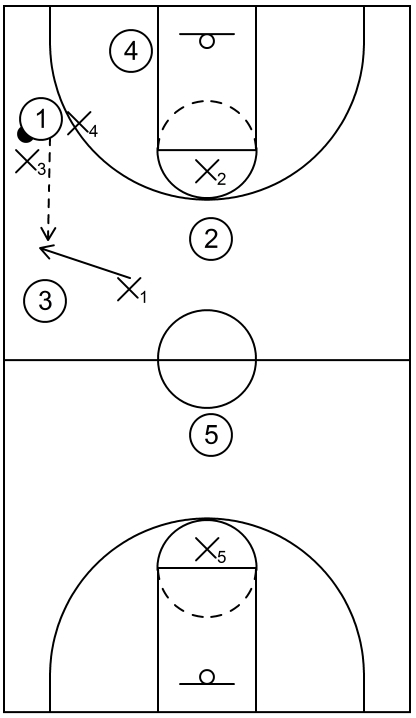
Basically, 1 gets trapped by X3 and X4 so 3 is the recipient of the pass from 1. However, X1 steps into the passing lane to get an interception, which also produces a live-ball turnover.
What are additional insights to consider about the 1-2-1-1 press defense?
A trapped offensive player successfully passes the ball to the middle
If the trapped offensive player is able to pass the ball to a teammate in the middle, especially because of a missed interception opportunity, then the press is effectively broken and the defenders will be in a scramble.
The example diagram demonstrates this in more detail.
When the press gets broken in the middle, X1 should immediately slide back towards the middle area to stop the ball while the other defenders scramble to find adjacent offensive players to guard against, represented by the gray arrows.
Alternatively, defenders could sprint into the frontcourt to set up a zone defense.
A trapped offensive player successfully passes the ball down the sideline
If the trapped offensive player successfully passes the ball down the sideline to a teammate, especially because of a missed interception opportunity, then the press is basically broken and defenders will be at a significant disadvantage.
The example diagram shows how this action could potentially look.
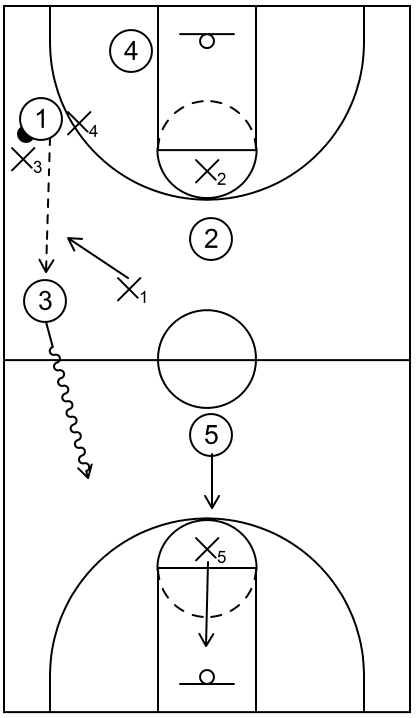
When the ball is successfully thrown down the sideline, most of the defenders won’t be able to properly scramble as they are behind the ball.
So, the most effective option is for X5 to immediately drop back to protect the basket because the offensive team will more than likely have a numbers advantage, particularly between offensive players 3 and 5.
A trapped offensive player throws a backwards pass to the safety
When a trapped offensive player throws a backwards pass to the inbound player, who acts as a safety option, then one of the trapping defenders can release to guard the ball. That same defender could also try to push the safety down the sideline while other defenders move to certain areas of the court as well.
The example diagram below demonstrates this in more detail.
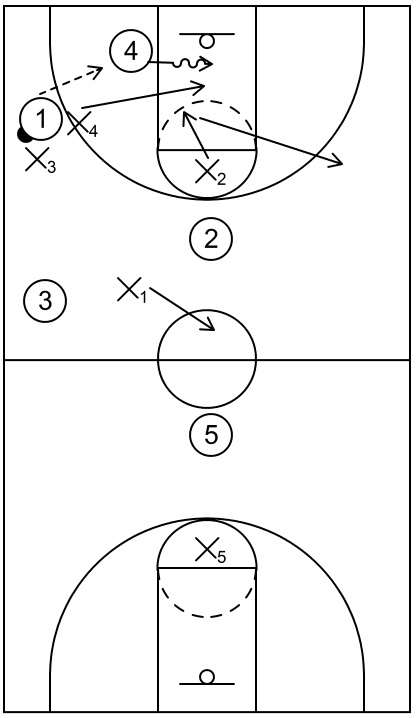
This is an example of the 1-2-1-1 press defense that showcases ball movement from one side to the other in the backcourt during the initial trap action. To start, 1 gets trapped but decides to pass the basketball to 4.
If that happens, X2 could stunt at the ball while X4 recovers to player 4 who would most likely dribble back towards the key near the basket. Afterwards, X2 could cut back to the right side wing area while X1 cuts back toward the middle near the half court line.
X4 can also try to influence 4 down the opposite sideline, which could lead to another potential trap or even a time violation such as a 10-second count.
What is an advantage of the 1-2-1-1 press defense?
One particular advantage of the 1-2-1-1 press defense is that it could be beneficial for teams that have speed, quickness, great conditioning, but less than ideal individual offensive skill sets.
Essentially, if a team is not very good at shooting the basketball, especially from three-point range, and/or a team is average or below average at generating scoring opportunities via dribble drive action (e.g. slashing to the basket, primarily via dribble penetration), then that team could implement the 1-2-1-1 press to gain extra offensive possessions by way of defensive interceptions or other types of possible turnovers such as an inaccurate pass by the offensive team that goes out of bounds.
In other words, the team that executes the 1-2-1-1 press could use their defensive skills to compensate for their average or less than average offensive talents. For example, if the defensive team is able to generate live-ball turnovers, primarily via interceptions, especially in the backcourt, then this could lead to quick and easy points near the basket via transition offense.
What is a disadvantage of the 1-2-1-1 press defense?
One notable disadvantage of the 1-2-1-1 press defense is that there is only one defender in the back of the press to protect the basket. This basically means that if the offensive team is able to break the press, then the offensive team will most likely have a numbers advantage.
In simple terms, if the offensive team is able to get the ball into their frontcourt, essentially breaking the press, either via pass penetration into the middle area of the press or by another method to avoid/circumvent the defensive traps, then the offensive team would most likely have the opportunity to score near the basket via quick layups or from the mid-range/three-point line via open jump shots.
This scenario could occur because the defender in the back of the press would not be able to guard two or more offensive players if those players break the press in one way or another.
So, the 1-2-1-1 press defense could be thought of as a high risk, high reward defensive strategy. In other words, defensive teams that decide to implement this particular press have an opportunity to create scoring opportunities, particularly in the backcourt, by way of live-ball turnovers.
Yet, those same defensive teams could potentially get scored on multiple times if the offensive team possesses the basketball IQ to break the 1-2-1-1 press.
Affiliate Disclosure: I may earn a commission on qualifying purchases made through the links below.