What is the 3-2 zone defense in basketball?
The 3-2 zone defense is a basketball defensive strategy that restricts dribble penetration with adequate on-ball defense while hindering scoring opportunities, especially around the basket, and influencing poor shot selection, particularly near the perimeter areas of the court.
How to understand the player roles and diagrams on this page
In reference to any diagrams below, each of the offensive and defensive players are generally represented by the standard basketball positions, unless otherwise noted.
Additionally, offensive players are signified by numbers such as 1-5 while defensive players are indicated by the letter X, which is then followed by numbers such as X1-X5.
In essence, 1 and X1 indicate the respective offensive and defensive point guards. 2 and X2 signify the respective offensive and defensive shooting guards.
3 and X3 denote the respective offensive and defensive small forwards. 4 and X4 designate the respective offensive and defensive power forwards.
5 and X5 represent the respective offensive and defensive centers.
Moreover, in terms of a brief legend for the diagrams:
- Black Dot or Small Circle: The black dot or small circle represents the basketball.
- Solid Arrow: The solid arrow indicates movement or a cut on the basketball court.
- Dotted Arrow: The dotted arrow represents a basketball pass.
- Wavy Arrow: The wavy arrow indicates dribbling.
- T-Shaped Symbol: The T-shaped symbol signifies a screen, also known as a pick.
- Double pipe symbol: The double pipe symbol denotes handoff action.
What is an example of the 3-2 zone defense when the ball is at the top?
When an offensive player has possession of the ball at the top, one of the topside defenders could apply moderate pressure or even more depending on that offensive’s player scoring ability, especially from three-point range.
The diagrams below demonstrate this in more detail.
Moderate pressure when the ball is at the top
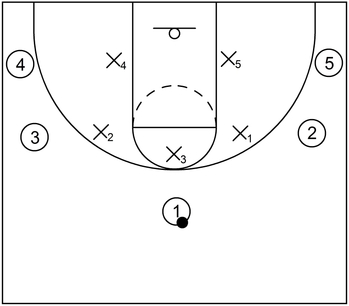
First, let’s assume in this case that 1 has below average three-point shooting ability and is therefore, not a dangerous threat from long-distance. As a result, X3 only needs to apply a moderate amount of pressure and so remains near the high post area.
In essence, X1 and X2 are near the free throw line extended areas inside of the three-point arc prepared to closeout if 1 were to pass the ball to one of the offensive players near the wing areas.
Lastly, X4 and X5 simply cover the low post areas for the time being.
Greater pressure when the ball is at the top
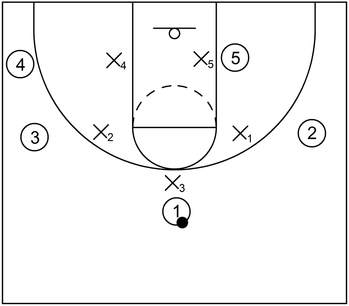
In this instance, 1 has the ability to shoot from three-point range. Therefore, X3 should generally step up above the three-point line at the top area to apply a greater amount of defensive pressure.
What’s more, 5 has decided to establish position near the right side low post area as opposed to being near the right side corner such as from the previous diagram. As a result, X5 could slide into the lane area while essentially covering 5.
What is an example of the 3-2 zone defense rotation when the ball is on the wing?
When an offensive player has possession of the ball on the wing, a topside defender could guard the ball while another topside defender covers the high post area on ball side.
Other defenders can guard the lane and deny a potential post entry pass on ball side.
The example diagram below demonstrates this concept.
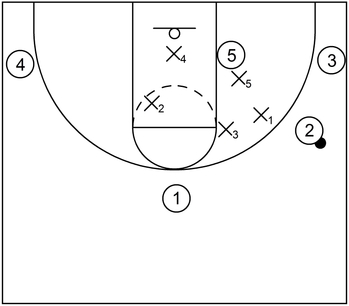
Essentially, when that happens, X1 slides toward the ball and executes a closeout to prevent an open jump shot. X3 drops back to the high post elbow area to prevent middle dribble penetration.
X5 can front against 5 to take away the post entry pass. Also, as that happens, X4 can slide into the lane to protect the basket on the back side.
Additionally, X2 could potentially slide into the lane to take away a potential basket cut by 1.
What is an example of the 3-2 zone defense rotation when the ball is in the corner?
When an offensive player has possession of the ball in the corner, one of the backside defenders can rotate to guard the ball while other defenders cover certain areas to limit offensive capabilities.
The example diagram demonstrates this concept.
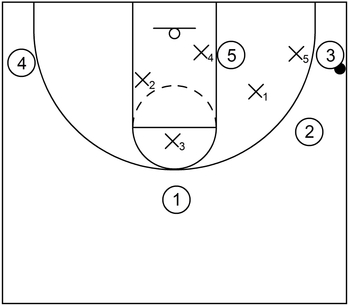
When that occurs, X5 executes a closeout to prevent the uncontested three-point shot while also not giving up baseline dribble penetration.
X1 drops back to fill in the gap between 2 and 5, essentially to mitigate middle dribble penetration and to prevent an easy post entry pass from the corner.
Additionally, X4 slides over to guard 5 while X3 covers the high post area. Lastly, X2 covers any weak side action.
What is an example of the 3-2 zone defense rotation when the ball is in the low post?
When an offensive player has possession of the ball in the low post, two backside defenders could double team to limit a high percentage scoring opportunity around the basket.
Other defenders can also cover certain areas within the 3-2 zone. The example diagram below illustrates this point.
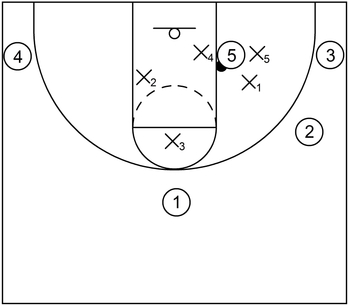
In that case, X4 and X5 could double team the post with high hands to prevent any opportunity to take a quality shot near the basket.
Additionally, X1 could dig at the ball and attempt to steal it without getting assessed a personal foul.
Moreover, X3 continues to cover the high post area while X2 continues to watch for weak side offensive action.
What is an example of the 3-2 zone defense featuring a trap in the corner?
When the ball is in the corner, one of the topside and backside defenders could set a trap while another adjacent topside defender denies a passing option for the trapped player.
Other defenders could guard within the lane area to prevent certain offensive actions.
The example diagram below demonstrates this concept.
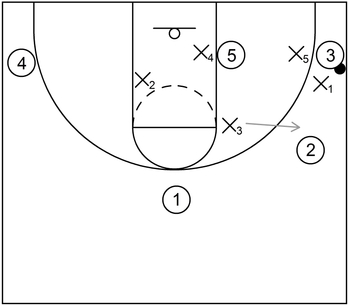
Essentially, X1 and X5 execute the corner trap with high hands and as that occurs, X3 has the option to intercept the ball (shown with the gray arrow) if 3 attempts to pass to 2.
However, it should also be noted that X3 should initially stay near the high post and then afterwards, anticipate when 2 might receive the pass from 3.
Basically, if X3 commits too early towards 2 before 3 executes the pass, then 3 could throw a skip pass to 1 instead.
If that were to happen, then X3 would probably not have enough time to recover to guard 1 at the top and that would effectively break down the zone.
What is an example of the 3-2 sliding zone defense variation?
In essence, the topside defender, who was initially in the middle of the other two topside defenders, could generally cover the high post area when the ball is at the top or on the wing. However, if the ball is in the corner, then that defender could slide towards the low post area instead.
The example diagram below demonstrates this point.
In addition, it’s based on insights within Championship Gap Man-to-Man and Sliding Zone Defense by Jack Bennett.
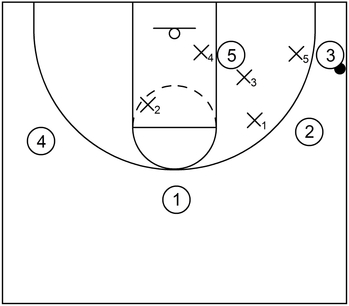
On the adjacent diagram, the ball is in the corner and because of that, X3 slides down towards the low post and can front against 5 on the high side. Furthermore as an added bonus, X3 sliding down towards the low post makes it challenging for 3 to dribble towards the middle.
At the same time, X4 guards 5 on the low side near the baseline. This, in essence, makes it very difficult to execute a post entry pass from the corner.
However, if the ball does happen to get into the low post area, that would create an automatic double team between X3 and X4.
Also, it should be noted that in the 3-2 sliding zone defense, even if 5 was not positioned near the strong side low post block, X3 would still drop down near the low post block while X4 stays in front of the basket.
This would effectively prevent an offensive player from simply cutting to the low post block to receive the ball from the corner.
In other words, in the 3-2 sliding zone defense, once the ball gets to the corner, the defensive objective is to keep the ball from getting into the low post, even if a offensive low post player is not currently positioned near the strong side low post block.
What are advantages of the 3-2 zone defense?
One notable advantage of the 3-2 zone defense is that it could be effective against teams that prefer to score near the basket via one or more of their low post players, especially if those post players have above average low post skills.
Also, another strength of the 3-2 zone defense is that it could be useful against teams that do not have multiple three-point shooters, especially players that can shoot from the wings or corners.
Furthermore, teams that prefer to create scoring opportunities via dribble drive action could have problems against the 3-2 zone defense.
What is a disadvantage of the 3-2 zone defense?
One particular disadvantage of the 3-2 zone defense is that it essentially requires all five defenders to have a certain level of speed and quickness in order to execute proper defensive closeouts towards the perimeter areas of the court.
This, in turn, could prevent uncontested perimeter jump shots or undesirable dribble drive execution.
In other words, if the offensive team passes the ball around the perimeter, specifically near the wings or corners, then each of the zone defenders have to be fast enough to closeout and cover those same perimeter areas.
However, if a zone defender is not able to closeout to their respective perimeter area quickly enough or the zone defender executes a poor closeout, then that could lead to an open jump shot or dribble penetration towards the basket for the offensive team.