What is basketball offense?
Basketball offense is a system that primarily consists of strategies and tactics alongside skill sets, which are carried out by teams to win the game by scoring more points than their opposition.
By implementing and executing basketball offense, teams give themselves a chance to break down the defense and ultimately score the maximum amount of possible points efficiently and effectively.
How to understand the player roles and diagrams on this page
In reference to any diagrams below, each of the offensive players are generally represented by the standard basketball positions in number format, unless otherwise noted.
In essence, 1 is the point guard; 2 is the shooting guard; 3 is the small forward; 4 is the power forward; 5 is the center.
Additionally, in terms of a brief legend for the diagrams:
- Black Dot or Small Circle: The black dot or small circle represents the basketball.
- Solid Arrow: The solid arrow indicates movement or a cut on the basketball court.
- Dotted Arrow: The dotted arrow represents a basketball pass.
- Wavy Arrow: The wavy arrow indicates dribbling.
- T-Shaped Symbol: The T-shaped symbol signifies a screen, also known as a pick.
- Double pipe symbol: The double pipe symbol denotes handoff action.
What is a 1-4 low play example within basketball offense?
This is an example of a 1-4 low play within basketball offense featuring pick and pop action plus a flare screen to potentially create a scoring opportunity for one of the post players.
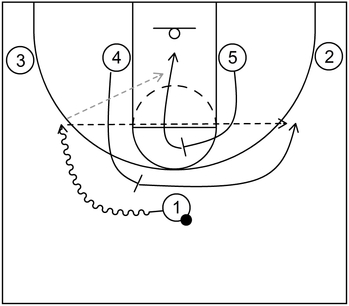
To start, 1 dribbles towards the left side wing via the ball screen set by 4.
Immediately following that, 4 cuts to the right side wing via the flare screen set by 5 who also rolls to the basket.
Next, 4 receives the skip pass over the top from 1 and can take the three-point jump shot if open.
Additionally, 5 could receive the ball from 1 as a secondary option, shown with the dotted gray arrow. Afterwards, 5 could score near the basket.
What is a baseline runner play example within basketball offense?
This is an example of a baseline runner play within basketball offense that utilizes multiple screens to produce a possible scoring opportunity for the team’s best shooter.
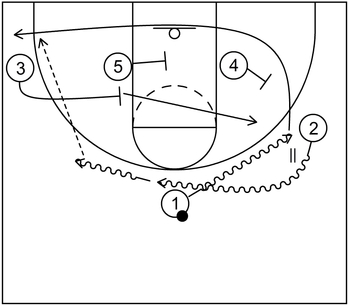
To begin, 1 dribbles toward the right side wing to execute a dribble hand-off with 2. Next, 2 dribbles toward the left slot area while 1 cuts across to the left side corner via the screens set by 4 and 5.
Additionally, 3 could set a quick brush screen if the defender that covers 1 decides to cheat over the top of the screen.
After that, 3 continues the cut across to the right side wing area. As that happens, 1 receives the ball from 2 and takes the open jump shot.
Related: Mississippi State Baseline Runner – YouTube
What is a box set play example within basketball offense?
This is an example of a box set play within basketball offense that mainly features down screens to create a scoring opportunity for the team’s best three-point shooters.
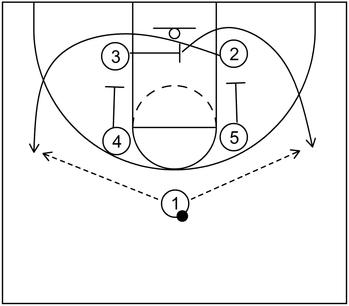
To begin, 2 cuts to the left side wing via the screen set by 3 in addition to the down screen set by 4.
As that happens, 3 cuts to the right side wing via the down screen set by 5. Following that, 2 or 3 could receive the ball from 1 and take open jump shots.
Related: Kelvin Sampson’s “Floppy” Basketball Offensive Set: Chicago! – YouTube
What is a dribble weave play example within basketball offense?
This is an example of a dribble weave play within basketball offense that also includes spread pick and roll action.
Part 1: Slot to slot and through cut
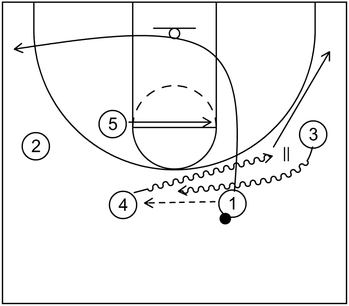
To begin, 4 receives the ball from 1 who cuts through to the left side corner. Next, 4 dribbles toward the right side wing to execute the dribble handoff with 3. After that, 3 dribbles back toward the top.
At the same time, 4 continues the cut to the right side corner while 5 cuts across from the left side elbow to the right side elbow.
Part 2: Spread pick and roll
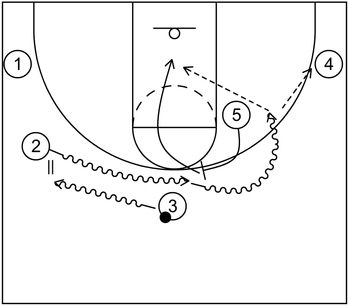
3 continues to dribble toward the left side wing to execute the dribble handoff with 2. Following that, 2 dribbles back toward the top and then receives a ball screen from 5.
After setting the pick, 5 rolls to the basket and could receive the ball from 2 if open. Additionally, 2 could take the open jump shot or pass to 4 if open.
Related: Warriors Weave – YouTube
What is an example of a basketball offense passing drill?
This is an example of a basketball offense passing drill that requires at least two players who will pass the ball to each other while moving from one end of the court to the other.

Players 1 and 2 begin on one side of the court near a baseline facing each other.
Also, for the example, player 1 starts under the basket in the lane with possession of the ball while player 2 starts behind the three-point line in the corner.
However, it is possible for player 1 to space out even more across the lane, especially when throwing the overhead pass.
From that point, the players can work on throwing the basic chest pass, bounce pass, or overhead pass to each other.
For example, let’s say that the players want to practice throwing the chest pass.
So, at the start of the drill, player 1 throws a chest pass with 2 as the receiver while sliding down the court.
Moreover, player 2 begins sliding down the court mirroring player 1’s movement while catching the ball.
Afterwards, player 2 throws a chest pass back to player 1 while both players continue sliding down the court, remaining in sync of each other’s movement.
Player 1 throws another chest pass back to player 2 while sliding and this pattern continues until both players reach the opposite baseline.
From there, the two players could start the drill again and throw the bounce pass to each other or the overhead pass to each other.
Additionally, the players can even mix in different passes as well. For example, player 1 could throw the chest pass while player 2 throws the bounce pass.
As another example, player 1 could throw the overhead pass while player 2 throws the chest pass.
What are the types of basketball offense?
The types of basketball offense consist of various categories of offensive formations, patterns, or distinctive systems that also include a common characteristic of creating scoring opportunities to ultimately win basketball games.
The names of the various categories for the different types are generally known as set offense, zone offense, press offense, transition offense, continuity offense, motion offense, and inbound plays.
Set Offense
A set offense features specific plays, also known as set plays, offensive strategies, or quick hitters that are typically designed to create scoring opportunities for the team’s best players.
Additionally, a set offense usually implements a certain offensive formation during the initial phase of the offense.
For example, the box offense strategy, which is also a set offense, starts with one player at the top and four additional players near the low posts and high posts elbows.
When each of the four players near the various posts fill those areas, the formation looks similar to a box, hence its name.
Furthermore, a set offense usually consists of a predetermined path (e.g. get the ball to the best three-point shooters or low post players) but if that path is unsuccessful for whatever reason, then the set generally has to start over again or the team has to implement another set.
Zone Offense
A zone offense consists of one or more offensive strategies formulated to beat one or more types of zone defense.
As an example, the short corner zone offense could be implemented against the 2-3 zone defense by attacking its soft spots, which of course, are the short corners.
Press Offense
A press offense, also referred to as a press break, includes specific plays and formations that are designed to counter against one or more press defenses, particularly in the full court.
Transition Offense
A transition offense, also generally referred to as a fast break, comprises special offensive strategies known as primary break, secondary break, or the numbered fast break.
The main objective of transition offense is to score points quickly and efficiently, particularly during the transition from defense to offense and before the opposing team can protect their own basket, adequately match up, or implement complete defensive formations.
Continuity Offense
A continuity offense incorporates specific patterns of cuts, screens, passes, or dribble actions that are then executed in a continuous manner on both sides of the floor until the offensive team procures the best available shot near the basket or near the perimeter.
Motion Offense
A motion offense is devised of unique offensive strategies that typically consist of certain rules or principles players should follow to generate scoring opportunities near the basket or near the perimeter.
Additionally, many motion offenses can utilize elements of set offenses to produce scoring options for the team’s best players.
However, unlike set offenses, which are generally more rigid, the players involved in a motion offense can usually read the defense and react accordingly.
Furthermore, most motion offenses are also flexible enough to perform similar to continuity offenses as well.
Therefore, if the offensive team is not able to score with the initial actions of the motion offense, then that same team could potentially execute the offensive action once more as a continuity pattern.
Inbound Plays
Inbound plays occur when an offensive player is able to execute a throw-in while standing behind a sideline or baseline.
Moreover, inbound plays typically occur after stoppage of play and they are usually ran for the team’s best players, similar to set offenses. Therefore, inbound plays could be thought of as a sub-type of set play.
What are strategies of basketball offense?
Strategies of basketball offense are essentially planned, structured actions, styles, or systems implemented by the coaching staff and generally utilized by all five offensive players on the floor to reach the ultimate objective of scoring points.
Additionally, various strategies could be associated with the different types of basketball offense and each strategy could utilize one or more tactics to achieve success.
For example, the Horns offense is a strategy that is associated with the primary set offense type.
It is because the Horns offense uses half court set plays that are typically predetermined to create scoring opportunities for the team’s best players.
As another example, the 5 out motion offense is a strategy that is associated with motion offense as well as continuity offense.
It is because the 5 out motion offense is a read and react system, it consists of certain rules for the players, and it can be implemented as a continuity pattern.
1-4 High Offense
The 1-4 high offense is a basketball offensive strategy that primarily utilizes the high post as well as the wing areas to create scoring opportunities near the basket or near the perimeter, typically with a variety of basketball cuts and/or basketball screens.
The initial formation of the 1-4 high offense consists of an offensive player with the ball at the top, two players near the wing areas, and two players near the high post elbow areas.
1-4 Press Break
The 1-4 press break is a basketball offensive strategy that can be used as a counter against press defenses such as the 1-2-1-1 diamond press, the 2-2-1 press, the 1-2-2 press or a full court man to man press.
2 Out 3 In Motion Offense
The 2 out 3 in motion offense is a basketball offensive strategy that emphasizes ball movement, post split action, and continuity patterns to create scoring opportunities near the basket or near the perimeter.
The formation of the 2 out 3 in motion offense includes two players above (or outside) the free throw line extended area and three players below (or inside) the free throw line extended area.
3 Out 2 In Motion Offense
The 3 out 2 in motion offense is a basketball offensive strategy that seeks to create multiple scoring opportunities through the use of set plays as well as offensive actions such as basketball screens, basketball cuts, continuity patterns and pick and roll options among others.
The formation of the 3 out 2 in motion offense begins with three perimeter players near the tops and wings as well as two players near the low post blocks.
4 Out 1 In Motion Offense
The 4 out 1 in motion offense is a basketball offensive strategy that creates scoring opportunities via a variety of sequences such as basketball cuts, basketball screens, and dribble drive action.
Also, the typical formation of the 4 out 1 in motion offense starts with two players in the slot areas near the top, two players on the wings (or the corners in some instances), and another player near the low post.
5 Out Motion Offense
The 5 out motion offense is a basketball offensive strategy that utilizes the fundamental skills of passing, cutting, and screening as well as continuity patterns to create scoring opportunities, typically near the basket or near the perimeter.
Within the 5 out motion offense, each player should fill one of the perimeter areas of the top, wings, or corners.
Box Offense
The box offense is a basketball offensive strategy that utilizes a variety of off-ball and on-ball screens to create scoring opportunities, particularly for the team’s best scorers.
The formation of the box offense is a player at the top, two players near the high posts, and two more players near the low posts.
Circle Offense
The circle offense is a basketball offensive strategy that utilizes cuts and continuity patterns to create scoring opportunities near the basket.
Additionally, the circle offense features five players that should fill the perimeter spots near the top, the wings, and the corners, similar to the standard 5 out motion offense.
Flex Offense
The flex offense is a basketball offensive strategy that creates scoring opportunities near the basket or near the perimeter by way of two types of basketball screens known as the flex screen and the down screen.
Hawk Offense
The Hawk offense is a basketball offensive strategy that utilizes various basketball screens such as a high post screen and stagger screens to create scoring opportunities near the basket or near the perimeter.
Horns Offense
The Horns offense is a basketball offensive strategy that emphasizes spacing to create scoring opportunities near the basket or near the perimeter by way of various actions such as basketball screens and dribble handoffs.
The initial formation of the Horns offense begins with a primary ball handler at the top, two players near the high posts, and two additional players in the corners.
Princeton Offense
The Princeton offense is a basketball offensive strategy that utilizes the fundamental skills of cutting, dribbling, passing, screening, and shooting as well as three unique series of actions known as Chin, Low and Point to create scoring opportunities near the basket or near the perimeter.
Additionally, the Princeton offense typically begins with two guards near the slot areas, two wing players, and one additional player near the high post or low post.
Shuffle Offense
The shuffle offense is a basketball offensive strategy that utilizes the shuffle cut, certain types of basketball screens, and a possible continuity pattern to create scoring opportunities near the basket or near the perimeter.
Stack Offense
The Stack offense is a basketball offensive strategy that begins with a stack formation that also includes a variety of basketball screens to produce multiple scoring options for the offensive team’s best players.
Swing Offense
The Swing offense is a basketball offensive strategy that incorporates basketball screens, ball reversal, and continuity patterns to generate various scoring options.
Triangle Offense
The triangle offense is a basketball offensive strategy that utilizes three players to assemble a sideline triangle on one side of the court while emphasizing a two-man game between two additional players on the opposite side to create scoring opportunities by way of various offensive actions.
UCLA Offense
The UCLA offense is a basketball offensive strategy that focuses on the fundamentals of passing, screening, as well as cutting to create various scoring opportunities.
Wheel Offense
The Wheel offense is a basketball offensive strategy that features cutting and screening actions as well as continuity patterns to produce scoring opportunities near the basket or near the perimeter.
Primary Break
The primary break is a basketball offensive strategy that occurs as soon as one particular team transitions from defense to offense by gaining possession of the ball, either by way of a live-ball turnover, a missed shot, or a made basket by the opposing team.
Additionally, the primary break emphasizes scoring as quickly as possible, especially near the basket, before the defense is able to completely match up with their respective assignments.
Secondary Break
The secondary break is a basketball offensive strategy that occurs after the defensive team is able to prevent primary break.
Additionally, all five defenders have not entered into the frontcourt or all five defenders in the frontcourt are not evenly matched up with proper assignments.
As a result of that inadequate defensive formation, the offensive team could counter with the secondary break to generate scoring opportunities near the basket or near the perimeter.
Numbered Fast Break
The numbered fast break is a basketball offensive strategy that seeks to create quick scoring opportunities via transition offense principles and by designating certain numbers and specific roles to each of the five players.
What are tactics of basketball offense?
Tactics of basketball offense are effective and practical actions that are executed to produce an advantageous outcome for the team as a whole.
Additionally, basketball offensive tactics are generally performed by at least two or three players at any specific time and they are typically a part of a larger overall basketball strategy.
The usual tactics implemented within basketball offense include pick and roll, pick and pop, pass and cut, pass and screen away, high low, dribble handoffs, ball reversal, and screen the screener.
Pick and Roll
The pick and roll, also known as an on-ball screen, is one of the most common offensive tactics utilized in the game of basketball.
The pick and roll occurs when a player without the ball gets close to a player with the ball to set a pick. Next, the player without the ball that set the pick follows up by rolling to the basket.
Afterwards, the player with the ball could use the screen and then pass the ball to the player that rolled to the basket. From that point, the player that rolled to the basket could receive the ball if open and score near the rim.
Pick and Pop
The pick and pop is a variation of the pick and roll and it could be implemented as an alternative tactic to create additional scoring options within basketball offense.
In the pick and pop sequence, instead of rolling to the basket, the player that set the screen should pop out to an area on the perimeter, usually near the top or the wings.
Pass and Cut
The pass and cut action is a simple tactic that could be used in any particular basketball offensive strategy or set offense.
As the name implies, an offensive player with the ball simply passes it to a teammate and then cuts to the basket or to another open area of the court.
One basic advantage of passing and cutting is that it keeps the offensive players in constant motion. This, in turn, could lead to potential defensive breakdowns and subsequent scoring opportunities.
Pass and Screen Away
The pass and screen away action is another basic tactic that could be implemented within a number of basketball offensive strategies or set offenses.
As the name implies, an offensive player with the ball simply passes it to a teammate and afterwards, that same passing player sets a screen away from the ball for another teammate.
High Low
The high low action is a basketball tactic that can be used by offensive teams to create easy scoring opportunities near the basket.
To execute the high low action, one offensive player fills the top or high post while another player fills the low post block.
Following that, the player in the high post or at the top receives the ball and then the other player near the low post block quickly cuts into the lane around the basket.
Afterwards, the player near the basket receives the ball from the player at the top or high post and can quickly score at the rim with a layup or dunk.
Dribble Handoff
The dribble handoff is a basketball offensive tactic that occurs when a player in possession of the ball dribbles toward a teammate, followed by a handoff for that same teammate.
The dribble handoff could be utilized to release defensive pressure or as a way to create scoring opportunities for the player receiving the ball, either at the rim or near the perimeter.
Ball Reversal
Ball reversal is a common basketball offensive tactic that occurs when the ball gets passed from one side of the court to the other side, typically from the wings to the top or via skip passes.
Screen the Screener
Screen the screener is a basketball offensive tactic that occurs when one player receives a screen after setting a screen for another teammate.
This simple screening action could cause defensive breakdowns, which, in turn, could lead to multiple scoring options for the offense.
What are additional insights for offensive players?
- Utilize height/size: An offensive player could take advantage of their opponent by utilizing their height and/or size.
- Utilize speed and/or quickness: An offensive player could take advantage of their opponent by using their speed and/or quickness.
- Perform hustle plays:
- Offensive players could box out for offensive rebounds when possible. This can give their team more second chance opportunities to score points.
- Offensive players should also fight for loose balls without committing fouls when necessary.
- Don’t be indecisive: Offensive players should be aggressive and not indecisive when possible. For example, if an offensive player is open for a jump shot, they should take it with a high degree of confidence.
Affiliate Disclosure: I may earn a commission on qualifying purchases made through the links below.
Related: Lessons From the Legends: Basketball Offense Sourcebook – Jerry Krause & Ralph Pim