What is the 1-3-1 press defense in basketball
The 1-3-1 press defense is a type of basketball defensive strategy that implements on-ball pressure, particularly in the backcourt, and traps near the sidelines, especially in the frontcourt, to limit or prevent offensive scoring opportunities.
How to understand the player roles and diagrams on this page
In reference to any diagrams below, each of the offensive and defensive players are generally represented by the standard basketball positions, unless otherwise noted.
Additionally, offensive players are signified by numbers such as 1-5 while defensive players are indicated by the letter X, which is then followed by numbers such as X1-X5.
In essence, 1 and X1 indicate the respective offensive and defensive point guards. 2 and X2 signify the respective offensive and defensive shooting guards.
3 and X3 denote the respective offensive and defensive small forwards. 4 and X4 designate the respective offensive and defensive power forwards.
5 and X5 represent the respective offensive and defensive centers.
Moreover, in terms of a brief legend for the diagrams:
- Black Dot or Small Circle: The black dot or small circle represents the basketball.
- Solid Arrow: The solid arrow indicates movement or a cut on the basketball court.
- Dotted Arrow: The dotted arrow represents a basketball pass.
- Wavy Arrow: The wavy arrow indicates dribbling.
- T-Shaped Symbol: The T-shaped symbol signifies a screen, also known as a pick.
- Double pipe symbol: The double pipe symbol denotes handoff action.
What is an example of the initial formation for the 1-3-1 press?
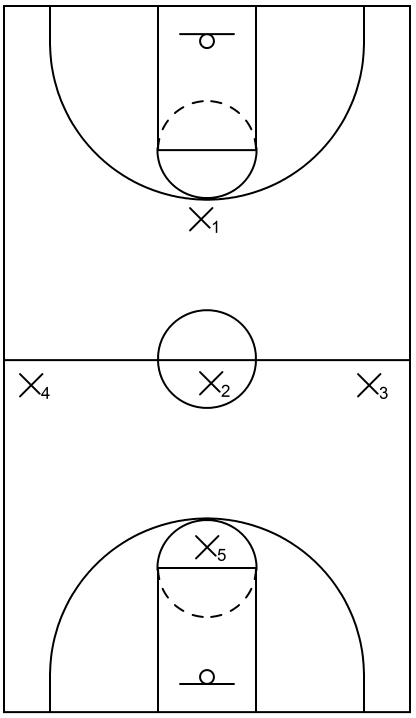
In relation to the initial formation, X1 starts at the top above the three-point line in the offensive team’s backcourt area.
Conversely, in the offensive team’s frontcourt, X2 starts near the half court center circle. Also, X3 and X4 start near the half court corners while X5 starts near the high post area.
The responsibilities of X1 are to execute initial backcourt defensive pressure, influence the player in possession of the ball to dribble towards the sideline, set traps, particularly in the frontcourt, and in some instances, protect the middle of the court.
The responsibilities of X2 are to protect the middle of the court, deny frontcourt entry passes towards the wing or middle, and set traps near the sideline. The responsibilities of X3 and X4 are to set traps near the sidelines or protect the middle of the court.
The responsibilities of X5 is to cover the high post area in the frontcourt or protect the basket, especially if one or more offensive players cut below the free throw line extended area in the frontcourt.
What is an example of the 1-3-1 press when the ball is initially in the backcourt?
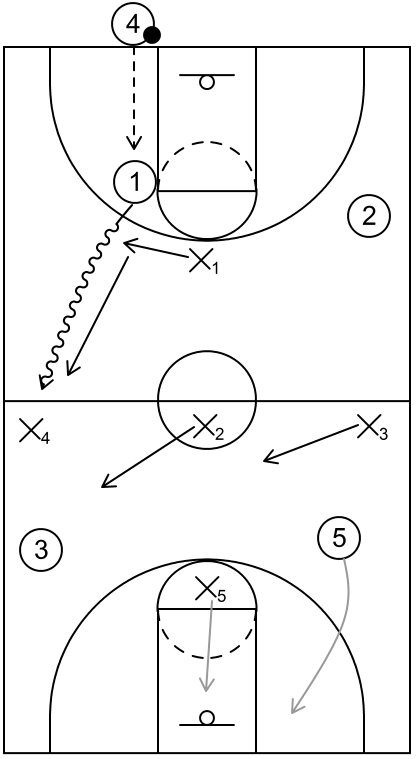
This is an example of the 1-3-1 press defense that demonstrates the defensive action prior to the sideline trap in the offensive team’s backcourt.
To start, 1 receives the inbound pass from 4 and following that, X1 influences 1 to dribble towards the sideline via defensive pressure.
As that occurs, X2 begins to slide over towards the ball side near the frontcourt wing area while X3 cuts to the middle of the court. Also, X5 covers the high post area.
However, if an offensive player such as 5 cuts below the free throw line extended, then X5 could drop back into the lane to protect the basket. This is shown on the diagram with gray arrows.
What is an example of the 1-3-1 press that demonstrates the first potential trap?
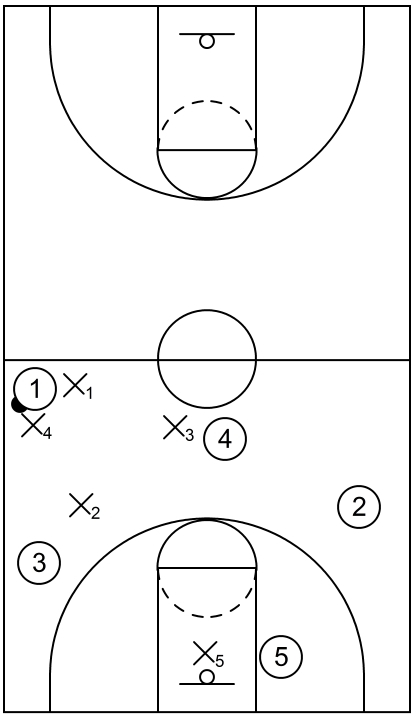
This is an example of the 1-3-1 press defense that demonstrates the first potential trap once the ball enters into the frontcourt.
To begin, X1 and X4 set the trap near the sideline and at the same time, X2 denies the possible pass to the wing area while X3 denies the pass towards the middle. Also, X5 continues to protect the basket.
What is an example of the 1-3-1 press that demonstrates the second potential trap?
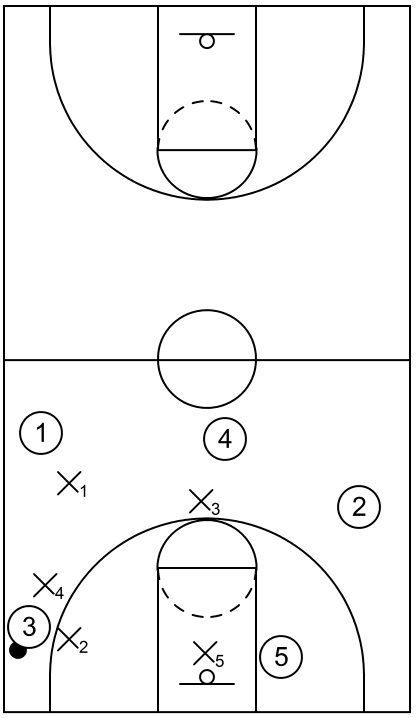
This is an example of the 1-3-1 press defense that features the second potential trap near the corner area. To start, X2 and X4 set the trap and as that occurs, X1 denies the potential pass to 1.
Also, X3 covers the middle of the press near the top of the three-point line while X5 continues to protect the basket.
What is an example of the 1-3-1 press that demonstrates a potential backwards pass in the backcourt?
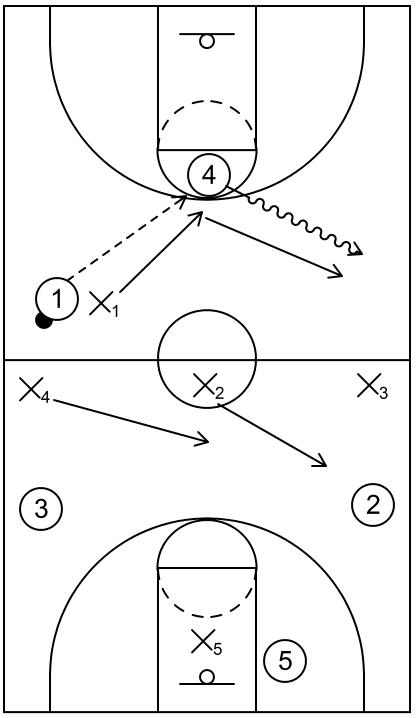
This is an example of the 1-3-1 press that features a backwards pass in the backcourt prior to the first potential trap.
In essence, instead of dribbling into the trap area, 1 proceeds to pass the ball backwards to 4.
Next, on the flight time of the pass to 4, X1 quickly executes a defensive closeout and afterwards, X1 influences 4 to dribble towards the sideline.
Additionally, X2 cuts towards the ball side wing area and X4 slides over to protect the middle area. Furthermore, X5 continues to protect the rim if there is at least one offensive player below the free throw line extended area.
What is an example of the 1-3-1 press that demonstrates a potential skip pass in the backcourt?
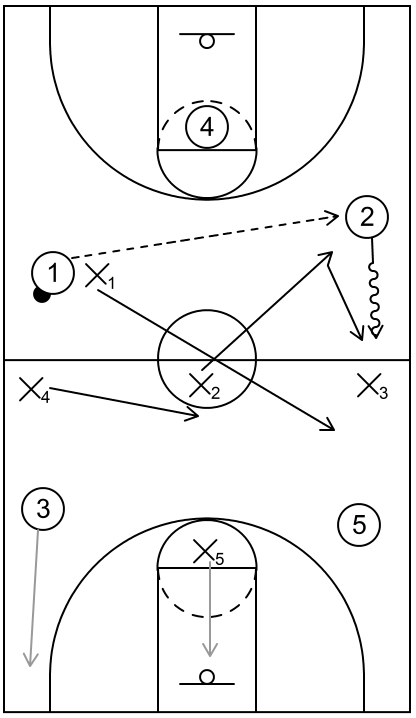
This is an example of the 1-3-1 press that shows a potential skip pass in the backcourt prior to the first potential trap.
When that happens, X1 most likely will not have enough time to perform a defensive closeout. Therefore, X2 could move towards the ball instead and influence 2 towards the sideline. That defensive action could also lead to a potential trap on that side of the court.
At the same time, X1 then sprints across the court to deny a potential pass towards the ball side wing area while X4 sprints across to cover the middle area that was recently vacated.
Also, X5 could cover the high post area or drop back towards the basket if one or more of the offensive players cuts below the free throw line extended, as represented by the gray arrows.
What is an advantage of the 1-3-1 press defense
One particular advantage of the 1-3-1 press defense is that it has the capability of creating defensive pressure but at the same time, the defensive team does not necessarily have to aggressively focus on generating offense from defense, primarily via live-ball turnovers unlike a few other types of press defenses.
To put it simply, the 1-3-1 press defense is more or less a containment-type press that seeks to disrupt the rhythm and flow of the offensive team and force them to execute several passes as they attempt to break the press.
It is also from these extra passes that could lead to possible turnovers as every additional pass increases the chances of the offensive team making mistakes.
However, as mentioned previously, the general emphasis is not necessarily on the turnovers themselves, but on disrupting the offensive flow first.
What is a disadvantage of the 1-3-1 press defense
One general disadvantage of the 1-3-1 press defense is that there is only one defender at the bottom of the press to protect the basket.
So, if the offensive team is able to pass through the front-line defense at the top and in the middle, then the lone defender in the frontcourt may become vulnerable.
Especially if the offensive team creates a numbers advantage that occurs when there are two or more players available to score near the basket.