What is zone offense in basketball?
Zone offense is a type of basketball offense that utilizes actions such as screens, cuts, and ball reversal against zone defenses to ultimately create scoring opportunities near the basket or near perimeter areas of the court.
What are example demonstrations of zone offense?
Zone offense example demonstrations could include various series vs. different types of zones.
How to understand the diagrams and player roles via a brief legend
In reference to any diagrams below, each of the offensive and defensive players are generally represented by the standard basketball positions in number format, unless otherwise noted.
- 1 through 5: 1 through 5 represents the offensive point guard (1), shooting guard (2), small forward (3), power forward (4), and center (5), respectively.
- X1 through X5: X1 through X5 indicates the defensive point guard (1), shooting guard (2), small forward (3), power forward (4), and center (5), respectively.
- Black Dot or Small Circle: The black dot or small circle represents the basketball.
- Solid Arrow: The solid arrow indicates movement or a cut on the basketball court.
- Dotted Arrow: The dotted arrow represents a basketball pass.
- Wavy Arrow: The wavy arrow indicates dribbling.
- T-Shaped Symbol: The T-shaped symbol signifies a screen, also known as a pick.
- Double Pipe Symbol: The double pipe symbol denotes handoff action.
1-2-2 zone offense series
Example 1

To begin, 1 passes the ball towards the opposite slot, which is received by 4. Afterwards, 4 dribbles toward the left side wing area.
This action will also most likely cause X3 to slide towards the ball. Otherwise, 4 would have an open three-point shot opportunity.
What’s more, as 4 dribbles, 1 cuts down to set a screen on X2, ultimately to create space for 5 to cut into the gap of the zone. 1 could also pop to the right side wing after setting the screen.
From there, if the gap is open, then 5 could receive the ball from 4. That could lead to an open mid-range jump shot if 5 possesses shooting capability.
Moreover, it is not shown on the diagram but if 5 has dribbling ability, then 5 could attack the rim, which would essentially influence either X4 or X5 to protect the basket.
After that, 5 could throw a kick pass to either 2 or 3, which could result in three-point shot opportunities.
However, if X1 were to slide down to take away the middle gap so that 5 could not receive the ball, then 4 could pass to the adjacent corner where 2 is currently located.
At that point, it is likely that X5 will closeout to guard the ball because 2 would have a three-point shot opportunity if left open.
Also, as 2 receives the ball, 5 could quickly cut to the basket before X4 is able to slide over into the lane and take away the pass. Following that, 5 could receive the ball from 2 and score via a layup.
Example 2

To start, 1 passes the ball towards the opposite slot, which is received by 2. After that, 2 begins to dribble towards the left side wing. This also influences X3 to cover the ball while X1 drops back to take away the middle.
As that dribble action happens, 3 begins running the baseline from the right side corner towards the left side corner, utilizing a screen set by 4.
Moreover, after setting the screen, 4 runs the baseline behind the zone defenders and takes up space near the dunker spot.
Next, 3 receives the ball from 2 and takes the three-point shot if that is open. Otherwise, if X5 was able to fight through the screen to guard against 3, then 5 could dive cut into the lane. Following that, 5 receives the ball from 3 and possibly scores by way of a layup.
Nevertheless, if X4 slides over to protect the basket, then 4 could receive the ball from 5. Afterwards, 4 could take one dribble towards the lane and then try to score around the rim.
Alternatively, 4 could also cuts toward the lane to meet the ball followed by a layup attempt at the basket.
In addition to those options, if X2 drops back to provide help, then 1 could cut down towards the right side wing, receive the ball from 5, and take the three-point shot.
1-3-1 zone offense series
Example 1
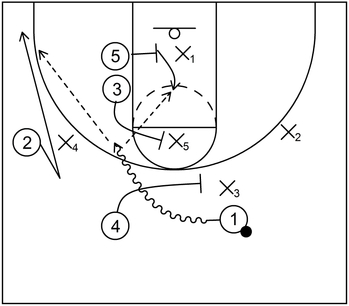
To begin, 1 dribbles into the gap of the zone near the left side high post via the on-ball screen set by 4. At the same time, 1 also receives another on-ball screen from 3 while X1 gets cross screened by 5.
As that action happens, 2 drifts toward the left side corner from the left side wing. Following that, 2 could receive the ball from 1 and take the open three-point jump shot.
Additionally, 5 could quickly post up after setting the cross screen, receive the ball from 1, and then score with a low post move near the basket.
Example 2
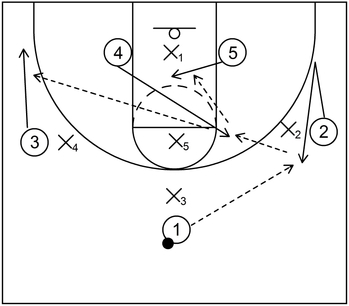
To start, 2 makes a v-cut to get open and receives the ball from 1.
Next, 4 executes a flash cut across the lane to the right side high post elbow and receives the ball from 2. Afterwards, 5 quickly ducks into the lane, seals the defender under the basket, receives the ball from 4 via high low action, and scores near the basket with a low post move.
Also, if the high low option is not there, then 4 could execute a skip pass to 3 who flattens to the left side corner for a three-point shot opportunity.
2-1-2 zone offense series
Example 1
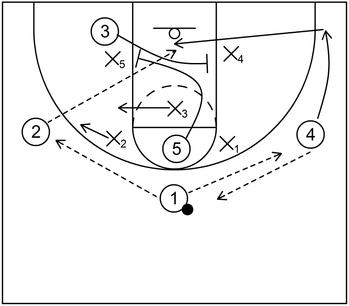
To start, 4 receives the ball from 1, reverses it back to the top immediately, and then cuts to the right side corner. Next, 2 receives the ball from 1 which seeks to shift the zone.
After that, 3 and 5 set screens on the back side zone defenders. As that happens, 4 cuts to the basket, receive the ball from 2 and score before the defense can recover.
Example 2
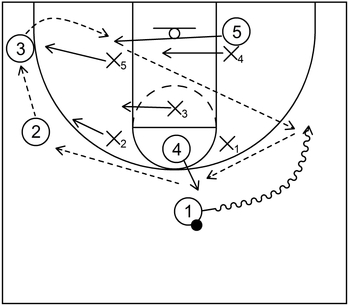
To begin, 1 dribbles toward the right side wing and as that happens, 4 pops out from the high post to the top and receives the ball from 1.
Next, 2 receives the ball from 4 and then 3 receives the ball from 2. As this occurs, the zone should shift over towards the left side of the court.
Afterwards, 5 cuts across the lane to the left side low post area and can receive the ball from 3. From there, 5 can score near the basket or 1 could receive the ball from 5 via a skip pass and then take the open jump shot.
2-3 zone offense series
Example 1: Part 1
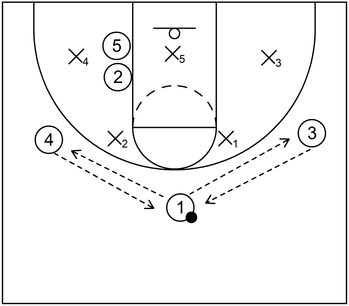
3 receives the ball from 1 and immediately reverses it back to the top. Next, 4 receives the ball from 1 and then reverses it back to the top once again.
The main emphasis of the reversal action is to shift the defenders from side to side, ultimately to open up gaps within the zone.
Example 1: Part 2
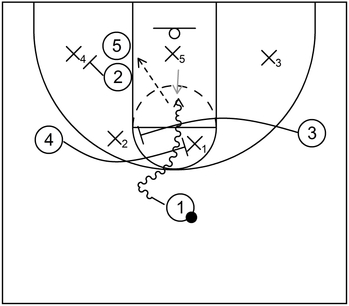
Immediately after the second reversal pass, 4 receives a ram screen from 3 who cuts across the high post area. From that point, 4 uses the ram screen to set an on-ball screen for 1.
Next, 1 uses the on-ball screen and quickly splits the two defenders at the top of the zone. At the same time, 5 uses a quick screen from 2 near the baseline.
Following that, 1 can take the mid-range jump shot in the lane. Also, 5 could receive the ball from 1 for a close range scoring opportunity if X5 steps up to contest the possible jump shot, shown with the gray arrow.
It should also be noted that this set was derived from Kansas Jayhawks men’s basketball team.
Example 2: Part 1
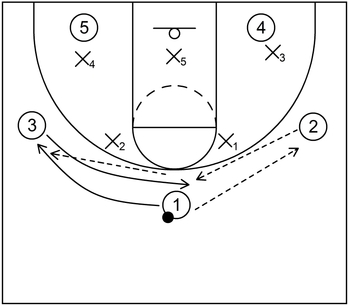
This action starts with a 3 out 2 in motion variation that has the post players at the short corners instead of the low post blocks. It is also derived from the Kansas State Wildcats men’s basketball team.
To begin, 2 receives the ball from 1 and following that, 1 and 3 interchange spots as the zone shifts. Afterwards, 3 receives the ball from 2 and then reverses it again to 1.
Example 2: Part 2
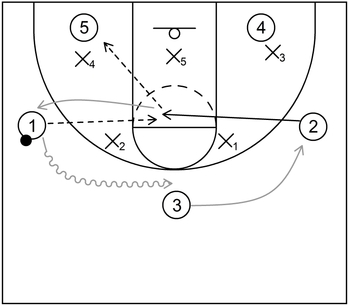
2 flashes into the middle of the zone and receives the ball from 1. At this point, 2 could shoot the mid-range jump shot if open. Also, 2 could make the high low pass to 5 at the short corner who could shoot the short jump shot/layup.
Additionally, there is an alternative option represented by the gray arrows. If 2 is not open after the flash cut occurs, then 1 could dribble towards the top.
At the same time, 2 continues the cut to replace at the left side wing and 3 cuts to the empty right side wing.
Example 2: Part 3

Continuing on, 2 receives the ball from 1 and as that happens, 4 quickly flashes into the gap of the zone. Next, 4 can take the jump shot if open. Alternatively, 5 could receive the ball from 4 and try to score via a field goal attempt from either the short corner or near the basket.
Example 3
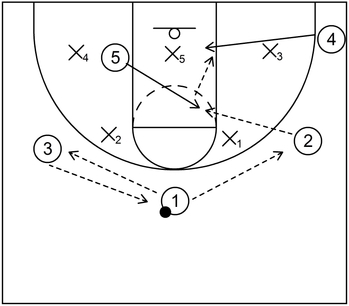
To start, 3 receives the ball from 1 and reverses it swiftly back towards the top.
Next, 2 receives the ball from 1 and as that happens, 5 flashes into the gap of the zone near the right side elbow.
Following that, 5 receives the ball from 2 and once that occurs, 4 performs a backdoor cut to the rim from the right side corner.
Afterwards, 4 receives the ball from 5 and scores near the rim by way of a layup or dunk.
This set is also derived from North Carolina men’s basketball team.
Example 4: Part 1
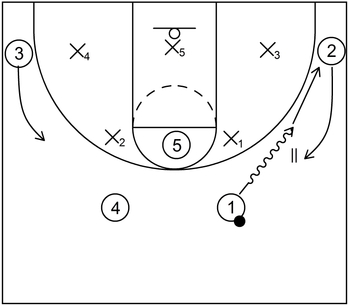
To begin, 1 dribbles toward the right side wing and as that happens, 2 and 3 lift up from the corners to the wings.
Next, 2 receives the ball from 1 via a dribble handoff and following that, 1 flattens to the vacant right side corner.
Example 4: Part 2
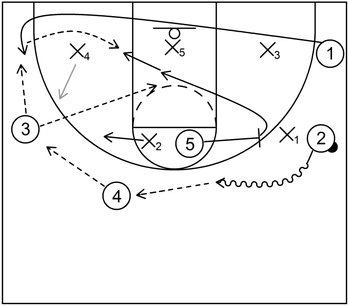
After receiving the ball, 2 dribbles toward the top via an on-ball screen set by 5. Following that, 4 receives the ball from 2 and quickly reverses it to 3. As that happens, 1 runs the baseline to the left side corner.
At the same time, 5 rolls toward the basket after setting the screen. From that point, 5 could receive the ball from 3 and score near the basket if that is open.
Additionally, if X4 slides up to take away the potential jump shot from 3, shown with the gray arrow, then 1 could receive the ball and take the three-point shot in the corner.
Nevertheless, if 1 received the ball but X4 was able to closeout near the corner, then 5 can continue the cut through to the left side low post block.
Following that, 5 could receive the ball from 1 and score near the basket, particularly by way of a low post move.
This set is also derived from the Michigan Wolverines’ men’s basketball team.
What is a general overview of zone offense principles?
- Space the floor:
- Good basketball spacing helps the offense move the ball more efficiently.
- This, in turn, could cause the zone to shift, which could lead to potential defensive breakdowns.
- Additionally, good spacing and ball movement could produce higher quality scoring opportunities, particularly via jump shots, against the zone defense.
- Screen the zone:
- Each defender covers a specific area within the various zone defenses.
- Therefore, setting basketball screens on those defenders could create gaps within the zone.
- That, in turn, could create separation for offensive players to score points, particularly from three-point range or even near the basket.
- Attack the gaps:
- Generally speaking, offensive players should consider attacking the gaps of the various zones as much as possible.
- This can be accomplished with dribble penetration.
- It’s also possible to achieve this via certain basketball cuts such as the flash cut.
- Generally speaking, offensive players should consider attacking the gaps of the various zones as much as possible.
- Reverse the ball:
- Ball reversal could be implemented within zone offense, specifically by passing the basketball from one side of the court to the other.
- Reversing the ball generally influences the zone defenders to shift from one area to another.
- This is primarily to track the ball and stay in front of any particular offensive player who would have possession of it.
- As a result of that action, gaps will most likely take shape, typically in the middle of the zone or on the weak side.
- Overload the zone:
- An overload occurs when there are more offensive players on one side of the court than defenders.
- A common overload within zone offense is to have a player on the wing, one in the corner, and another near the low post.
- When that occurs, there will usually only be two zone defenders on that same side.
- From there, one of those defenders would have the challenging task of trying to cover two offensive players.
- As a result, one of the three offensive players would more than likely be able to get open and receive the ball.
- Get the ball into the short corners:
- Generally speaking, there are open spaces in the short corners of the various zone defenses.
- Therefore, if the offensive team can get the ball into those short corners, then the defense could become vulnerable to breakdowns.
- Get behind the zone:
- Offensive teams should try to get behind the zone defenders whenever possible.
- This will help those players exploit the vulnerabilities of the zone because the defenders cannot efficiently guard what they cannot see.
- One of the ways to get behind the zone is to use the short corner as mentioned previously.
- Additionally, players could also run the baseline from one side to the other side, being sure to cut behind the zone defenders as well.