What is a down screen in basketball?
A down screen in basketball occurs when one offensive player faces the general direction of the baseline to set a screen on a defender who is guarding a second offensive player.
Following that, the second offensive player can then use the down screen to get open for a possible scoring or playmaking opportunity.
How to understand the player roles and diagrams on this page
In relation to any diagrams below, each of the offensive players are generally represented by the standard basketball positions in number format, unless otherwise noted.
In essence, 1 is the point guard; 2 is the shooting guard; 3 is the small forward; 4 is the power forward; 5 is the center.
Furthermore, in terms of a brief legend for the diagrams:
- Black Dot or Small Circle: The black dot or small circle represents the basketball.
- Solid Arrow: The solid arrow indicates movement or a cut on the basketball court.
- Dotted Arrow: The dotted arrow represents a basketball pass.
- Wavy Arrow: The wavy arrow indicates dribbling.
- T-Shaped Symbol: The T-shaped symbol signifies a screen, also known as a pick.
- Double pipe symbol: The double pipe symbol denotes handoff action.
What is a notable way to implement a down screen?
A notable way to implement a down screen is by using it in combination with another screening action such as a cross screen. That could lead to one or more scoring opportunities for the offensive team.
Additionally, the cross screen and down screen sequence results in a screen the screener instance, which could be challenging for the opposing defense to effectively guard against.
The example diagram below demonstrates this point even further.

To start the action, 1 passes the ball towards the right side wing, which is received by 2. After that, 5 cuts to the right side low post area, via a cross screen set by 3.
Next, 3 cuts to the top via the down screen set by 1 to complete the screen the screener action. From there, 3 could receive the ball from 2 and take the jump shot quickly if that is open.
Alternatively, 5 could receive the ball and score near the basket, particularly with a low post move.
Also, if 5 receives the ball, then 1 could cut towards the open space near the left side wing. However, if 3 receives the ball and takes the jump shot, then 1 is in a great position to get a potential offensive rebound.
What is a pin down screen?
A pin down screen is a sub-type of the standard down screen. It is commonly set at an angle towards the lane but still around the general vicinity of the baseline.
The example diagram below demonstrates the pin down screen via floppy action, which features a single pin down screen on one side and a stagger screen on the other side.

To start, 2 starts under the basket and could cut to the left side wing via the single pin down screen set by 5 or to the right side wing via the stagger screen set by 3 and 4.
In either case, 2 could receive the ball from 1 and take the open jump shot.
What is a wide pin down screen?
A wide pin down screen is a sub-type of the standard down screen. It is set at an angle towards a corner of the court but still near the general vicinity of the baseline.
The example diagram below demonstrates the wide pin down screen via the Horns offense.

To begin the action, 5 cuts toward the left side corner to set a wide pin down screen. From there, 2 uses that screen and cuts to the left side wing area and receives the ball from 1.
Next, 4 cuts toward the right side corner to set a wide pin down screen. 3 uses that screen and performs a curl cut to the basket.
After that, 3 could receive the ball from 2 and score at the rim with a layup or dunk. Also, 5 could pop to the short corner if their defender slid into the lane to protect the basket. Once that occurs, 5 could receive the ball from 3, which could result in a potential mid-range jump shot.
How could a team practice scoring near the basket with a down screen basketball drill?
To practice scoring near the basket, a team could set up a drill that has one player set a wide pin down screen while another player implements a curl cut.
The example diagram below showcases this concept with greater detail.
It should be stated as well that the player numbers do not necessarily represent the standard basketball positions in this case. Instead, those numbers are utilized for demonstration purposes.
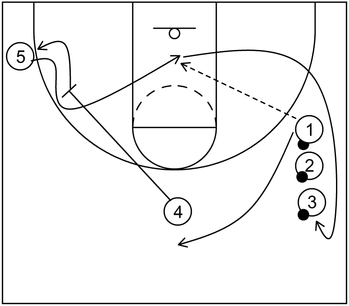
In terms of the drill setup:
- At least one player occupies the left side corner of the court. This corner player will cut to the basket.
- Two or more players fill the right side wing area. Those players will also have possession of a basketball and will pass it to the cutting player.
- At least one player fills the top and will set the wide pin down screen for the player near the left side corner.
To begin the drill, 4 cuts toward the left side corner to set a wide pin down screen for 5. Next, 5 uses that screen and executes a curl cut to the basket. After that, 5 could receive the ball from 1 and score at the rim with a layup or dunk.
To continue the drill, 5 would get the ball out of the basket ring after scoring, keep possession of it, and sprint to the back of the passing line near the right side wing.
Also, 4 would fill the vacant area near the left side corner and become the new cutter. Moreover, 1 would cut to the back of the line at the top and become the new screener.
It should also be mentioned that this drill is based on insights within Developing Interchangeable Perimeter & Post Players by Matt Painter.
What are possible defensive actions to limit the effectiveness of the down screen?
Jam the screen cutter
Essentially, when an offensive player executes a cut to get open via the down screen, that same player should generally have their inside shoulder as close as possible to the outside shoulder of the screener.
When the two offensive players involved in the down screen stay shoulder to shoulder, the defender who is the target of the screen is more or less forced to fight over the top of it or go under it, especially if that defender was initially chasing behind their offensive assignment.
As a result of that, the offensive player who used the screen would typically have at least a moderate amount of open space, even if that same player is only open for a second.
However, the defender who is the target of the down screen could mitigate or totally prevent the effectiveness of the screen by standing in the gap between the inside shoulder of their assignment and the outside shoulder of the screener, prior to the occurrence of the screening action.
In other words, if the defender who would be the target of a down screen is able to stay in front of the inside shoulder of the offensive player that they are currently guarding, then the down screen would be limited or totally ineffective.
Basically, when the defender is able to jam the screen cutter in this manner, this means that the screener and the cutter cannot get shoulder to shoulder with any noteworthy effect.
As a result, the defender executing the jam action does not have to fight through or go under the screen, which, in turn, eliminates potential open space for a possible jump shot or additional playmaking opportunity for the offensive player using the screen.
It should be also mentioned that an offensive player could possibly counter the defensive jam action with a backdoor cut or curl cut, particularly if there is open space in the lane.
In other words, the offensive player being jammed would essentially stop cutting towards the perimeter but counter by cutting towards the basket.
The offensive team could also utilize the floppy action as another type of counter to mitigate the jam action as well.
In that instance, an offensive player would cut towards the perimeter by way of a single or stagger screen and more specifically, the offensive player would cut to the perimeter via the screen in the direction that is opposite the defensive jam.
Related: Jamming an Offensive Player Using a Screen – YouTube
Go under
If the defender does not jam the screen cutter and is essentially chasing behind the cutter, then the defender could possibly close the open space between themselves and the cutter by going under the screen, which is also known as shooting the gap, in this instance.
By going under the down screen, the defender could potentially limit scoring or dribble penetration opportunities for the offensive player that utilizes the screen.
However, it should also be stated that an offensive player could counter with a fade cut if the defensive player decides to go under the down screen.
To give a brief example of that, let’s say that an offensive player initially desires to cut towards the right side slot after using a down screen but the defender guarding that same offensive player goes under the screen.
From that point, the offensive player could counter by simply changing the direction of their cut from the right side slot to the right side wing, or perhaps the right side corner.
When that occurs, the defender would probably not have enough time to execute a proper defensive closeout, which could then lead to an open jump shot or additional playmaking opportunities.
Defensive switching
In certain instances, the defender who is the target of the down screen and the screener’s defender could execute a defensive switch to mitigate the effectiveness of the down screen.
In other words, the defender who is being targeted by the down screen would not even attempt to jam the screen cutter or go under the down screen.
Instead, the screener’s defender would simply switch to guard the offensive player that used the down screen while the initial target of the down screen switches to guard the screener.
This could be highly effective if the two defenders involved in the switching action are versatile defenders that can guard multiple basketball positions.
However, it should be noted as well that an offensive player utilizing the screen could counter the switching action by setting a down screen themselves, particularly on the screener’s defender.
Afterwards, the screener could use that secondary down screen and take a potential jump shot or, the two players involved in the screening action could execute offensive measures such as dribble handoffs to generate scoring opportunities.
Affiliate Disclosure: I may earn a commission on qualifying purchases made through the links below.