What is the skip pass in basketball?
The skip pass consists of action that occurs when an offensive player in current possession of the basketball passes it to another non-adjacent offensive player, usually on the opposite side of the court.
What are examples that demonstrate the skip pass?
Example 1
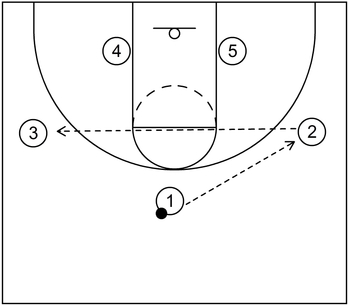
This is an example of a skip pass from one wing of the court to the opposite side. To start, 2 receives the ball from 1 and then executes a skip pass to 3 on the left side wing.
In this instance, instead of 1 receiving the ball again from 2 and afterwards, 3 receiving the ball from 1, the ball was simply skipped over 1 at the top.
Example 2
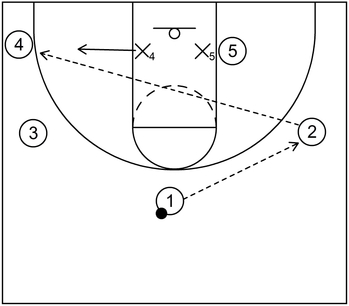
This is an example of a skip pass that occurs from one wing of the court to the opposite corner. To start, 2 receives the ball from 1 and following that, X4 slides into the lane to provide help if necessary against 5.
To counter that defensive action, 4 could receive the ball via the skip pass from 2. When that happens, X4 may not be fast enough to execute a proper defensive closeout on 4.
As a result, 4 might be able to take an open jump shot or possibly drive towards the basket.
Example 3
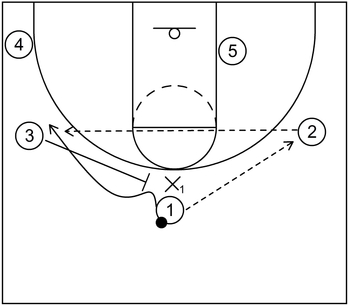
This is an example of a skip pass that occurs in combination with a flare screen. To begin, 2 receives the ball from 1. Following that, 1 cuts to the left side wing area via the flare screen set by 3.
Next, 1 could receive the ball again from 2 via the skip pass and take the three-point shot if open.
Example 4 – Part 1
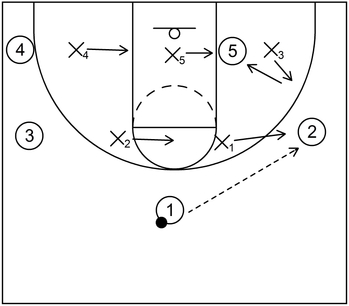
This is an example of the skip pass utilized against the 2-3 zone defense alongside a flare screen as well. To begin, 2 receives the ball from 1. This causes the zone defense to shift towards 2.
Example 4 – Part 2
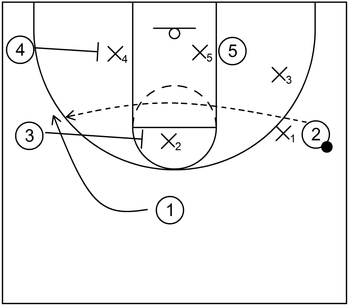
Next, 1 cuts to the left side wing via the flare screen set by 3 in addition to the screen set by 4. Afterwards, 1 receives the ball from 2 by way of a skip pass and takes the three-point shot if open.
What are the general benefits of the skip pass?
Potentially effective against weak side help defense
The skip pass could be potentially effective against help defense on the weak side, especially if a weak side defender, particularly during man to man defense, helps in the lane and therefore, moves too far away from their current assignment.
For example, let’s say that an offensive player has possession of the ball on the right side wing and that same offensive player would like to pass it to an above average low post scorer near the right side low post area.
At the same time, let’s also say a weak side defender near the left side corner leaves their assignment and slides into the lane to provide help in the event that the dominant low post player were to receive the ball.
The weak side defender may attempt to do this because the ball is technically at least three passes away from their current assignment.
However, to counter that defensive action, the offensive player near the right side wing could then skip the ball to the offensive teammate near the left side corner that was previously covered by the helping defender.
When that occurs, the weak side helping defender that is assigned to the offensive player near the left side corner will most likely not have enough time to execute a proper defensive closeout which could lead to a potential open jump shot for the offensive player in the left corner.
Moreover, even if the jump shot is not available, that same weak side defender assigned to the left side corner may execute a poor closeout which would then allow the offensive player that received the ball in the corner via the skip pass to get dribble penetration.
Afterwards, the corner offensive player in possession of the ball could dribble all the way to the basket for a layup or dunk, shoot a floater or runner in the lane, or perhaps, execute a kick pass so that another offensive teammate might have an opportunity to score or make a play.
Potentially effective against zone defense
The skip pass could be effective against zone defense because the zone defenders cover areas of the court as opposed to guarding against actual offensive players.
Therefore, when ball movement, and more specifically, ball reversal occurs during offensive execution, this causes the zone defenders to shift from one area to another.
As that occurs, this will generally create gaps within the zone defense. From that point, the offensive team could produce high quality jump shots, especially from three-point range.
Additionally, the offensive team could dribble into the gaps of the zone.
In other words, when the ball gets skipped from one area, and more particularly, from one side of the court to another side, the zone defender that is assigned to cover the new area may not have enough time to effectively closeout to prevent an uncontested jump shot.
Furthermore, that same zone defender could possibly execute an subpar closeout, which could then lead to dribble drive action into the gaps of the zone.
Potentially effective in combination with the flare screen
The skip pass can be used in combination with the flare screen to create a possible scoring opportunity.
Basically, when the ball is on one side of the court, it could be challenging for a defender that is being screened to keep track of the ball, their own assignment, and the screener setting the flare screen.
From that point, if the defender being screened gets caught on the flare screen, then the player receiving the ball via the skip pass could have a wide open shot.
Moreover, even if the defender being screened is able to avoid the flare screen, the screener could then flip it into pick and roll or pick and pop action.
This essentially means that the defender would have to avoid at least two basketball screens: the original off-ball flare screen and the current on-ball screen.
Also, even if the screener’s defender decides to execute a defensive switch, that could create a whole new set of problems, especially if the screener’s defender as well as the screener are post players.
In other words, if the screener’s defender executes a defensive switch to mitigate the effect of the flare screen but that same defender is not quick enough to contain the offensive player that received the ball after the flare screen action occurs, then this is essentially a defensive mismatch.
From that point, the defensive mismatch would most likely lead to easy dribble penetration towards the basket or at minimum, an open jump shot which could be the result of utilizing one or more dribble moves to create space between the offensive player in possession of the ball and the on-ball defender.
What is a potential downside of the skip pass?
A potential downside of the skip pass is that an off-ball defender, particularly near the weak side, could possibly deflect or intercept the pass because the ball is in the air for a longer period of time and it covers more space than a standard chest pass or bounce pass to an adjacent offensive player.
Furthermore, if a defender does indeed intercept the skip pass as opposed to simply deflecting it, then that would be a unfortunate turnover for the offensive team.
Therefore, offensive players should be adequately skilled at standard passing, and more specifically, making basic overhead passes before executing skip passes on a consistent basis.