What is the 1-2-2 zone defense in basketball?
The 1-2-2 zone defense is a basketball defensive strategy that seeks to limit low post scoring opportunities, restrict dribble penetration, and influence ineffective shot selection while executing on-ball pressure, particularly near the perimeter.
How to understand the player roles and diagrams on this page
In reference to any diagrams below, each of the offensive and defensive players are generally represented by the standard basketball positions, unless otherwise noted.
Additionally, offensive players are signified by numbers such as 1-5 while defensive players are indicated by the letter X, which is then followed by numbers such as X1-X5.
In essence, 1 and X1 indicate the respective offensive and defensive point guards. 2 and X2 signify the respective offensive and defensive shooting guards.
3 and X3 denote the respective offensive and defensive small forwards. 4 and X4 designate the respective offensive and defensive power forwards.
5 and X5 represent the respective offensive and defensive centers.
Also, in reference to general responsibilities, X1 executes defensive pressure against the player with the ball at the top and cover the high post areas.
X2 and X3 are to cover the wing areas or weak side areas while X4 and X5 cover the corner areas or guard the low post areas.
Moreover, in terms of a brief legend for the diagrams:
- Black Dot or Small Circle: The black dot or small circle represents the basketball.
- Solid Arrow: The solid arrow indicates movement or a cut on the basketball court.
- Dotted Arrow: The dotted arrow represents a basketball pass.
- Wavy Arrow: The wavy arrow indicates dribbling.
What are examples of 1-2-2 zone defense rotations?
Defenders can rotate to different areas within the 1-2-2 zone, primarily depending on the location of the ball.
When the ball is at the top
When an offensive player has possession of the ball at the top, the zone defender at the front could slide up to pressure the ball. Additionally, other zone defenders could cover near the high posts and low posts, respectively.
The diagram below illustrates this point.
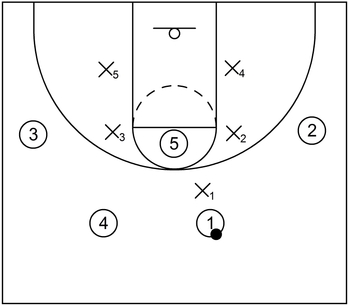
In essence, X1 executes defensive pressure against 1. As that happens, X2 and X3 cover the left and right side high post elbow areas. Moreover, X4 and X5 cover the left and right side low post areas.
What’s more, if 1 attempts to pass into the high post from that current position near the top, then either X2 or X3 should attempt to deflect or intercept that pass.
Furthermore, if 4 were to receive the ball from 1, then X1 should execute defensive pressure against that player as well.
When the ball is on the wing
When an offensive player has possession of the ball on the wing, one of the middle defenders could cover that wing area while the zone defender who was at the front could slide back to guard the high post area.
Additionally, strong side defenders in the back of the zone could cover near the corner and low post, respectively. Also, the weak side middle defender could cover near the mid-post lane line area.
The diagram below demonstrates this concept in greater detail.
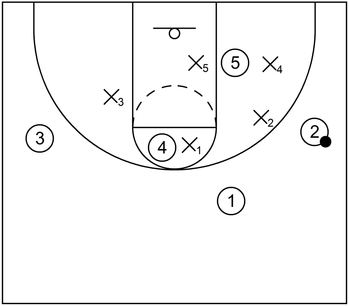
X1 can drop back to deny the high post entry pass. At the same time, X3 can drop back to watch for any weak side action such as cutting to the basket by 3.
Additionally, X2 covers the the right side wing area to prevent easy dribble penetration or uncontested jump shots. X5 guards the right side low post with a possible three-quarter front.
X4 can help on potential baseline dribble penetration or utilize active high hands to prevent the low post entry pass.
When the ball is in the corner
When an offensive player has possession of the ball in the corner, one of the backside zone defender could cover that area.
Moreover, one of the middle defenders can take away dribble penetration towards the middle as well as easy basket cuts on strong side.
Other defenders can guard the high post, low post, and weak side mid-post area, respectively. The diagram below demonstrates this with more details.
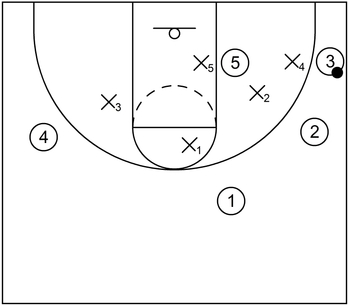
When the ball move to the corner, X4 executes a closeout to prevent an uncontested three-point shot. X2 drops back to help on potential middle dribble penetration or to prevent the low post entry pass.
X1 continues to cover the high post area while X3 continues to watch for any weak side action and X5 continues to guard the low post area.
When the ball is in the low post
When an offensive player has possession of the ball in the low post, two of the zone defenders could perform a double team on the ball while the other defenders continue to guard their respective areas.
The example diagram below gives more details of this concept.
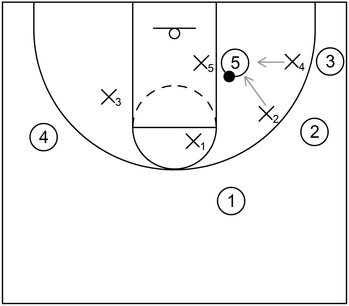
Essentially, X5 executes solid low post defense without fouling. Additionally, if either offensive players 2 or 3 are below average three-point shooters (whichever one is worst), then either X2 or X4 could execute double team action alongside X5, represented by the gray arrows.
Also, X1 continues to guard the high post area and X3 continues to cover the weak side.
What is an example of a 1-2-2 zone defense corner trap?
A corner trap within the 1-2-2 zone defense could feature a backside and topside defender trapping the player in possession of the ball. In addition, another topside defender could deny the next pass, which would be to the adjacent wing.
Other defenders guard below the free throw line and near the low post area, respectively.
The diagram below seeks to showcase this concept with more clarity.
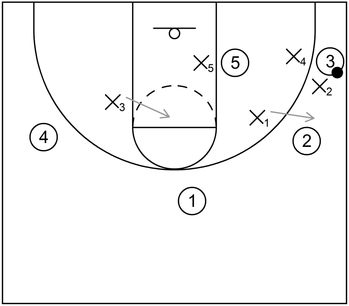
Once the ball gets passed to the corner, X2 (who would typically drop back to stand in the gap between the wing and the low post) will aggressively double team the ball with X4.
Both players should also have active hands to prevent the player in possession of the basketball from easily passing out of the trap.
At the same time, if there is an offensive player on the strong side wing (as shown on the diagram), then X1 (who would usually cover the high post area) could deny the potential pass to that wing player, represented by the gray arrow. Otherwise, X1 could simply continue to guard the high post area.
Additionally, if X1 denies the strong side wing and an offensive player were to cut towards the high post, then X3 could slide into the lane to temporarily guard the high post. Otherwise, X3 could continue to cover the weak side action as before. Also, X5 continues to defend the low post and protect the basket.
What are general principles of 1-2-2 zone defense?
Prevent high post touches
If the ball gets into the high post, this could create a problem for the defensive team. Therefore, it is necessary for the zone defenders to prevent opportunities for offensive players to receive the ball at the high post.
This is implemented by using denial defense with a hand in the passing lane between the ball and the high post offensive player.
Additionally, on-ball zone defenders should have active hands that mirror the hands of the ball handler in an attempt to make any potential high post passes more challenging and/or as a way to deflect the ball, which could lead to a possible turnover.
Limit or prevent low post touches
If the ball gets into the hands of a low post player with above average offensive skills, then that player could score quickly and efficiently against the nearest zone defender with a low post move.
So to alleviate this problem, the zone defender who guards that low post area could execute a three-quarter front against the offensive low post player by putting a hand in the passing lane between the low post player and the player with the ball that is near the wing or corner.
This will help prevent any easy post entry passes from those offensive players with the ball near the wing or corner.
As an alternative option, if the ball does get into the low post, then one of the strong side perimeter zone defenders near the wing or corner could double team the offensive low post player to influence that same player to pass the ball back to an offensive player near the perimeter.
Additionally, this type of double team strategy could be especially useful if the strong side wing or corner offensive players are below average shooters from the mid-range/three-point range.
Limit or prevent dribble penetration towards the middle
If the offensive team is able to attack the middle gap of the 1-2-2 zone defense with dribble penetration, particularly from the wing or corner, then this could lead to scoring opportunities.
Therefore, if the ball is on the wing, then the nearest off-ball zone defender should stand in the gap near the high post area.
In similar fashion, if the ball is in the corner, then the nearest off-ball defender should stand in the gap near the mid-post that is between the high post and low post area.
Limit or prevent uncontested jump shots
One of the main points of the 1-2-2 zone, like most zone defenses, is to influence jump shots. However, this does not automatically mean that offensive players should be able to freely take uncontested jump shots.
Instead, the defenders of the 1-2-2 zone defense should always try to closeout with good footwork and contest jump shots, even from below average shooters. This is specifically important for the defenders in the back of the zone whose basketball positions are usually the team’s power forward and center.
These defenders should emphasize executing good closeouts to prevent open jump shots and to limit dribble penetration because these same defenders are usually slower than the defenders in the front or middle of the zone.
What is an advantage of the 1-2-2 zone defense?
One notable advantage of the 1-2-2 zone defense is that it disrupts the offensive team’s ability to take uncontested jump shots, particularly from the wings. Another advantage is that it is possible to create quick turnovers by setting traps near the corners.
What is a disadvantage of the 1-2-2 zone defense?
One particular disadvantage of the 1-2-2 zone defense is that it could break down if the offensive team is able to get the ball into the high post area.
If that occurs, then this could lead to high low action, which typically involves a high post player executing a pass to a low post player for scoring opportunities around the basket.
Furthermore, if a player receives the ball in the high post, then that same player could also execute a skip pass to one of the two corners for three-point jump shot opportunities.
So, it is important that at least one defender covers the high post area and if a player on offense moves into the high post, then a high post defender could deny easy entry passes into that area.
Affiliate Disclosure: I may earn a commission on qualifying purchases made through the links below.
Related: Winning with the 1-2-2 Match-Up Zone Defense – Brenda Frese