What is 3 on 3 in basketball?
3 on 3 generally occurs when three players for one particular team compete on a basketball court against another three players from a different particular team, ultimately to win a game.
What is an example of 3 on 3 offense?
In terms of 3 on 3 offense, a player could dribble towards the wing while a second player sets a screen and a third player uses it to get open near the low post area.
The example diagram below illustrates this concept.
It should be noted as well that the numbers denoted as 1, 2, and 3 generally represent a point guard, a wing player, and a post player respectively.
However, this is primarily for demonstration purposes so it is possible for numbers and/or roles to change, depending on player preferences.
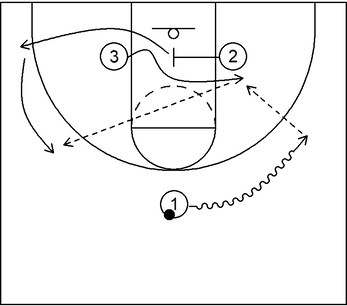
To start, 1 dribbles toward the right side wing area. Next, 3 cuts to the right side low post block via the cross screen set by 2, who also cuts to the left side corner.
Following that, 3 receives the ball from 1 and attempts to score via a low post move.
Also, if the weak side defender who would be covering 2 decides to help in the lane or even set a double team with the defender guarding 3, then 2 could lift up towards the left side wing and possibly receive the skip pass from 3, which could lead to an open jump shot opportunity.
What are the general rules for a 3 on 3 pickup basketball game?
This is a basic explanation of the general rules for a 3 on 3 pickup basketball game, which is commonly played among friends or random people at an indoor gym or on an outdoor court.
However, it should be noted that these rules are not set in stone and could vary based on player preferences.
Also, these rules would generally apply to other similar variants such as a 1 on 1, 2 on 2, or 4 on 4 pickup basketball game.
Half court
Players typically only use one half of the court and both team use the same basket for scoring purposes.
This is different when compared to full court play where both teams would have a backcourt as well as frontcourt.
Starting possession
The starting possession, or in other words, the team that gets to receive the ball first could be determined with something as simple as flipping a coin.
Nevertheless, some teams may elect to shoot the ball, usually from the free throw line or three-point line, to determine first possession.
Basically, in the event of taking shots, players from both teams could shoot the ball a certain number of times until one of the players from one particular team misses a shot.
Afterwards, the team that missed the last shot would then be the defensive team while the other team will have the starting possession on offense.
Points
In most instances of pickup play, when an offensive player makes a field goal inside of the three-point line, this is usually worth one point as opposed to the standard two points within formal play.
Moreover, when an offensive player makes a field goal outside of the three-point line, this is typically worth two points as opposed to the standard three-points within formal play.
Also, 3 on 3 pickup play typically does not implement a game clock that would normally determine the winning team that has the most points at the end of the timer.
Instead, in pickup, the team that scores a certain amount of points first would be the winner of the game.
It should also be mentioned that 3 on 3 pickup also does not usually include a shot clock so it is not necessarily for teams to shoot the ball within a specified number of seconds.
In terms of the points that a team needs to score to win the 3 on 3 pickup game, this is commonly between 10 points and 15 points in most cases. However, that number could be lower or higher depending on the players’ preferences.
It should be noted as well that sometimes within pickup play, a blowout or skunk rule could be established by the players.
This generally means that if one particular team has a significant lead in points that is much higher than the opposing team, then that same opposing team would automatically lose the game.
For example, if Team A has 8 points and Team B has 0 points (i.e. Team B did not score any points), then this might qualify as an automatic loss for Team B.
In addition to that, players might decide to institute a win by two rule. This basically means that one team has to have a two-point lead over the opposing team upon reaching or exceeding the final score, which would also be determined prior to the game.
For example, let’s say that the players agree that a team has to score at least 15 points to win the game. Let’s also say that both teams have 14 points at a certain point during the game.
From there, with the win by two rule in place, if Team A scores one point to increase their total to 15, then that same team would not win the game.
Following that, if Team B does not score and remains at 14 but Team A is able to score one or two points to increase the lead to 16 points or 17 points respectively, then Team A would win that particular game.
Rebounds
The rule for offensive rebounds is usually similar to the rules of formal full court play.
That is to say, when a player gets an offensive rebound, that same player can try to score immediately or if that is not feasible, then that same player could dribble the ball or pass it to a teammate.
However, the rule for defensive rebounding within a pickup game is usually different.
Essentially, within pickup play such as 3 on 3 action, when a player gains a defensive rebound, the ball usually has to clear a certain perimeter area of the court, which is commonly the three-point line.
That is to say, when a player gains possession of the basketball via a defensive rebound, that same player will typically have to dribble it behind the three-point line or pass it to a teammate who is already behind the three-point line.
The reason that this rule for defensive rebounding is usually instituted is because it gives the opposing team enough time to protect the basket since both teams do not have their own backcourt/frontcourt and both teams typically try to score in the same basket upon gaining possession of the ball.
Put another way, without this rule, a player who is initially on defense could potentially grab the rebound and quickly score before the opposing team is able to react and defend the basket.
In most cases, this would probably be an unfair advantage, especially if that same player possesses a height or athletic advantage over the competition.
Additionally, it should be mentioned if a player does not clear after receiving the defensive rebound, then the other team could call for a non-clear rule break and receive possession of the ball.
Conversely, in a full court game setting, when a player for a particular team collects a defensive rebound, this is the beginning of that same team’s transition offense.
Likewise, it is also the beginning of the opposing team’s transition defense. In other words, the team that was previously on defense has now transitioned into offense upon gaining possession of the basketball via the defensive rebound.
Similarly, the team that was previously on offense has currently transitioned into defense upon not gaining a secondary possession of the ball via an offensive rebound.
From that point, the new offensive team could dribble and/or pass the ball from their backcourt into their frontcourt, typically by way of fast break sequences such as primary break or secondary break as well as half court offensive series such as set plays, quick hitters or other strategies of basketball offense.
Simultaneously, the new defensive team has an opportunity to sprint into their backcourt, primarily to protect their basket and stop the new offensive team from scoring points.
Winner’s take or loser’s take
The winner’s take rule, which is sometimes referred to as “make it, take it” basically means that when an offensive team scores points, that same team would receive the ball immediately afterwards.
Essentially, with the winner’s take rule, if the offensive team can score continuously either by not missing shots and/or by grabbing offensive rebounds, which could lead to second chance points, then the opposing defensive team may not ever receive the ball in a game.
On the other hand, the loser’s take rule is opposite of winner’s take. That is, when the offensive team scores, the opposing defensive team receives the ball thereafter.
In a basic sense, the loser’s take rule allows both teams an opportunity to gain offensive possession of the basketball.
In terms of implementing winner’s take or losers’ take, this is typically determined by the players on the court prior to the game.
Inbound pass
After a made basket or valid call, one particular player on offense will commonly “take the ball out” on the opposite side of the midcourt line, which would also serve as the half court’s endline.
Afterwards, that same player can throw a inbound pass to a teammate and then play from there.
Check
After a made basket or valid call, one particular player on defense can say “Check!” to briefly receive the ball from the offensive player that would throw the inbound pass prior to offensive execution.
From there, the defender could examine the ball and/or determine that teammates are in proper position and ready to play.
Out of Bounds
Since players typically play on one half of the basketball court, the primary boundary lines will include the two sidelines as well as the adjacent baseline and midcourt line.
So, if a player on a team has possession of the ball and then that same player touches one of those boundary lines or passes over one of those lines, then this would be considered out of bounds.
Also, if any player was the last to touch the ball prior to it making contact with one of the boundary lines or the ball passes over one of those boundary lines, then that would be considered out of bounds as well.
From there, the opposing team would then receive the ball, usually at the top area near the midcourt line.
Also, as a side note, in formal full court play, if a team has possession of the ball in their frontcourt and the ball touches the midcourt line or passes over the midcourt line, particularly without it being last touched in the frontcourt by the opposing team, then this would be a backcourt violation.
Calls in relation to fouls or violations
Most of the time within pickup play such as 3 on 3 action, the players will make their own calls in relation to fouls or other violations.
In addition to that, when a potential dispute arises in reference to valid or invalid calls, one or more players from one team or both teams would typically shoot the ball from the free throw area or three-point line a certain number of times until someone misses a shot.
Following that, whichever player missed the last shot would lose the dispute and play could resume via the inbound pass near the top.
What is a brief history of 3 on 3?
In terms of a very brief history, primarily during the 1990s, 3 on 3 pickup basketball, which also contains less formal rules, became popular across a wide variety of indoor or outdoor courts by both casual and more serious basketball players.
Afterwards, in the mid-to-late 2000s, another variation known as 3×3 basketball, which also features more standardized rules, started gaining more recognition throughout various parts of the world and it was eventually organized by FIBA into an official format.
Following that, another 3 on 3 basketball league, known as BIG3, co-founded and popularized by notable hip hop musician and actor, Ice Cube, had its inaugural season in the year 2017.
What is a brief overview of the 3-man concept?
The general concept known as 3-man game is effectively 3 on 3 action that could occur within a 5 on 5 basketball game.
Essentially, in a 3-man game situation, three of the five offensive players work together to create scoring opportunities against three of the five defensive players.
This 3-man action generally happens on the strong side of the court but it could also be executed on the weak side in certain instances, usually by way of some type of off-ball screening action.