Ball reversal is a generally effective action in basketball because it can break down the defense, particularly on the weak side.
Essentially, when an offensive player passes the ball towards one side of the floor, defenders will typically shift in the direction of the ball.
However, if the ball is quickly reversed to the opposite side, the defenders on that same side, which would also be the current strong side, will most likely not be able to recover quickly enough to efficiently guard an offensive player with the ball on that side of the floor.
The shifting defenders may even have trouble effectively covering off-ball offensive players on that same side as well.
When that occurs, it could lead to defensive mistakes such as poor defensive closeouts, uncontested jump shots, or dribble drive penetration from a player on offense. All of those potential errors would be beneficial for the offensive team and detrimental to their defensive opposition.
What is ball reversal in basketball?
Ball reversal is a common tactic that occurs when an offensive team in possession of the basketball passes it towards one side of the court and then passes it back towards the other side.
What are other terms for ball reversal?
Ball reversal is sometimes also referred to as a reverse pass or simply reversing the ball.
When there is execution of a reverse pass or an offensive player is in the process of reversing the ball, that essentially means that the ball is currently on one side of the floor and it is being passed back towards the other side.
Ultimately, this can potentially lead to defensive breakdowns and create offensive scoring possibilities at the same time.
How to understand the player roles and diagrams on this page
In reference to any ball reversal diagrams below, each of the offensive or defensive players are generally represented by the standard basketball positions in number format, unless otherwise noted.
Additionally, offensive players are signified by numbers such as 1-5 while defensive players are indicated by the letter X, which is then followed by numbers such as X1-X5.
- 1 or X1 – Point Guard: The offensive point guard (1) is the primary ball handler generally responsible for initiating the offensive sets at the top above the three-point line in the middle of the floor. The defensive point guard (X1) typically guards the offensive point guard in man to man defense or typically covers the high post or wing area such as within the 2-3 zone.
- 2 or X2 – Shooting Guard: The offensive shooting guard (2) is usually stationed near one of the wings or corners to help with spacing the floor and is typically one of the offensive team’s best shooters. The defensive shooting guard (X2) guards the offensive shooting guard in man to man defense or covers the high post area and adjacent wing that is opposite the defensive point guard within 2-3 zone.
- 3 or X3 – Small Forward: The offensive small forward (3) typically fills the wing or corner that is opposite the offensive shooting guard. The offensive small forward could perform a number of skilled-based actions from cutting, passing, dribbling, or shooting. The defensive small forward (X3) typically covers the offensive small forward in man to man. The defensive small forward could also cover the general area near one of the low posts to the corner area within a zone coverage such as the 2-3. The defensive small forward could also temporarily lift up to cover the wing area within zone, which would usually happen during ball reversal from the offensive team.
- 4 or X4 – Power Forward: The offensive power forward (4) could fill either one of the low post or high post areas as well as one of the slots or wings. The offensive power forward could cut, screen, pass, dribble, or shoot. The defensive power forward (X4) generally guards the offensive power forward when implementing man to man coverage. Additionally, the defensive power forward could executes actions that are similar to the defensive small forward during zone coverage but on the opposite side of the court.
- 5 or X5 – Center: The offensive center (5) generally fills one of the high post or low post areas. The offensive center could also screen, cut, or shoot, usually around the basket. Conversely, the defensive center (X5) primarily guards the offensive center in man to man or covers the middle of the lane/basket during zone defense action.
Moreover, in terms of a brief legend for the diagrams:
- Black Dot or Small Circle: The black dot or small circle represents the basketball, especially while it is in possession of any particular offensive player.
- Solid Arrow: The solid arrow indicates player movement or a cut on the basketball court.
- Dotted Arrow: The dotted arrow represents a pass between offensive players.
- Wavy Arrow: The wavy arrow indicates dribbling by a player in possession of the basketball.
- T-Shaped Symbol: The T-shaped symbol signifies a screen (or pick) that is being set by an offensive player.
- Double pipe symbol: The double pipe symbol denotes handoff action between offensive players.
What is a ball reversal example via top to wing action?
This is an example of simple ball reversal that goes from the top to the wing, back to the top, and then to the opposite wing.
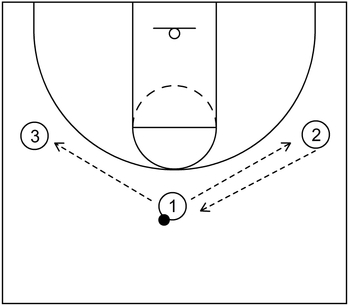
To start, 2 receives the ball from 1 and then quickly initiates the ball reversal action by passing it back to 1. Afterwards, 1 completes the ball reversal by passing it to 3.
What is a ball reversal example via skip pass action?
This is an example of ball reversal in which an offensive player passes the ball from the top to the wing and then another offensive player passes it again from one wing to the opposite wing.
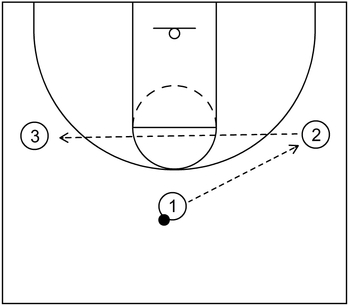
To begin, 2 receives the ball from 1 and quickly completes the ball reversal action by executing a skip pass to 3.
What is an example of a 3 out 2 in play with ball reversal?
This is an example of a 3 out 2 in basketball play that utilizes ball reversal to create a scoring opportunity near the basket.
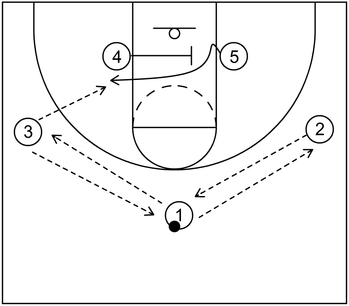
To start, 2 receives the ball from 1 and then initiates the ball reversal by passing it back to 1.
Afterwards, 3 receives the ball from 1 to complete the ball reversal and as that happens, 5 cuts to the left side low post via the cross screen set by 4. From there, 5 can score with a short jump shot or low post move.
What is an example of a flare play with ball reversal?
This is an example of a basketball play that features ball reversal alongside a flare screen to create a scoring opportunity around one of the perimeter areas of the court.
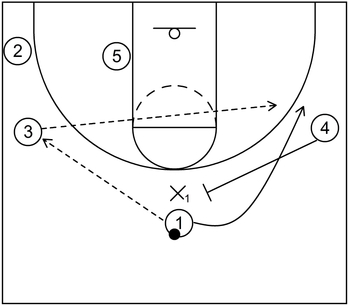
To begin, 3 receives the ball from 1 and after that, 1 cuts across to the right side wing via the flare screen set by 4.
Next, 3 completes the ball reversal by passing it to 1. Following that, 1 takes the open three-point jump shot.
What is an example of a Horns play with ball reversal?
This is an example of a basketball play from the Horns set that uses ball reversal by way of an on-ball screen and off-ball screen.
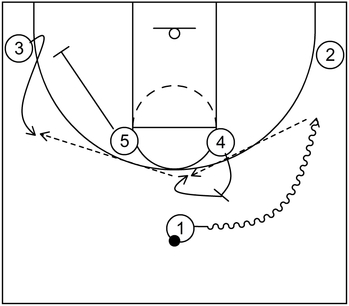
To start, 1 dribbles to the right side wing via the on-ball screen set by 4. From that point, 4 pops to the top and receives the ball from 1 to initiate the reversal action.
As that occurs, 3 cuts to the left side wing via the wide pin down screen set by 5. Afterwards, 3 receives the ball from 4 to complete the ball reversal. Following that, 3 could take the open three-point shot.
What is an example of a zipper play with ball reversal?
This is an example of a basketball play featuring ball reversal alongside a zipper cut, which could result in a potential perimeter scoring opportunity.
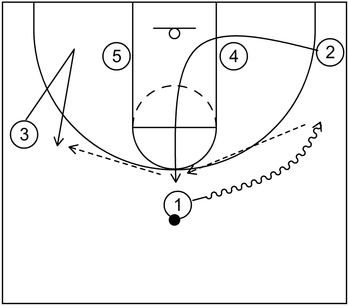
To begin, 1 executes a dribble entry to the right side wing. When that occurs, 2 executes a zipper cut to the top.
Next, 2 receives the ball from 1 to initiate the ball reversal. Afterwards, 3 gets open with a V-cut and then receives the ball from 2 to complete the ball reversal. From that point, 3 could take the jump shot if open.
What is an example of a zone offense play with ball reversal?
This is an example of a zone offense play that features ball reversal, particularly against a 2-3 zone defense.
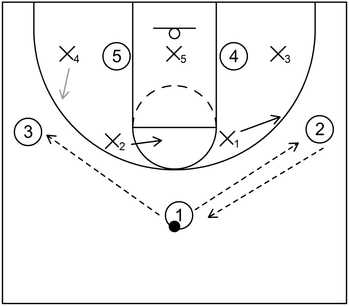
To start, 2 receives the ball from 1, which influences the zone defenders to shift. Afterwards, 2 initiates the ball reversal by passing it to 1.
Next, 3 quickly receives the ball from 1 to complete the ball reversal action. Once that occurs, 3 could could take the three-point jump shot if open. Also, when that happens, X2 would probably not have enough time to guard 2.
Therefore, X4 will most likely closeout to not give up an uncontested jump shot from 3. Following that, X2 could recover and then bump X4 to the back of the zone.
What is an example of a ball reversal drill?
This is an example of a ball reversal drill that primarily focuses on footwork and hand/eye coordination. It features players who cut to the high post from the wing and then towards the top to receive the ball.
Afterwards, a player in possession of the ball can reverse it to the opposite wing and the drill would begin once again on the weak side of the court.
This drill is also based on insights within Fast-Paced Skill Development Drills by Kelvin Sampson.
It should be noted as well that the players within the drills are not necessarily represented by the standard basketball positions.
Essentially, players 1 through 6 could be any particular positions.
Part 1: High post cut from the left side wing
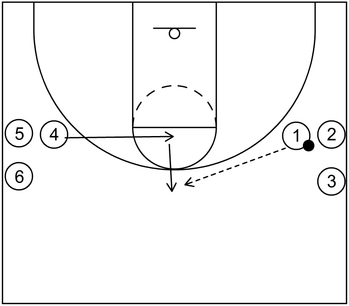
For the set-up, players form two lines on the left and right side wing areas.
For this example, the right side begins with the ball but in actuality, the left side could start with the ball as well. To begin, 4 immediately cuts to the high post area, pops out to the top, and then receives the ball from 1.
Part 2: Top to left side wing ball reversal
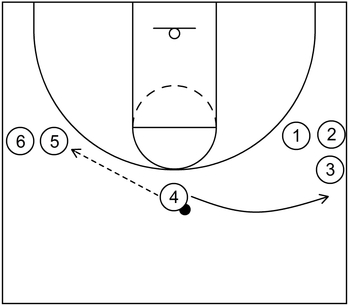
Next, 5 receives the ball from 4 to complete the ball reversal action. After that, 4 cuts to the back of the right side line.
Part 3: High post cut from the right side wing
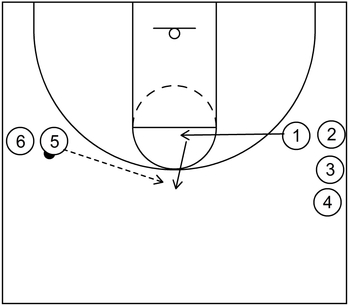
The drill begins again with 1 cutting to the high post area and then popping out to the top. Once that happens, 5 initiates the ball reversal by passing it to 1.
Part 4: Top to right side wing ball reversal
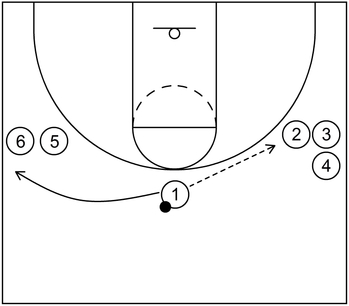
Next, 2 receives the ball from 1 to complete the ball reversal. Afterwards, 1 cuts to the back of the line on the left side.
It is not shown on the diagram but from this point, 5 would cut to the high post area, pop out to the top, and receive the ball from 2.
This drill could continue for a certain amount of time or until all of the players participated in each line at least one time.
Affiliate Disclosure: I may earn a commission on qualifying purchases made through the links below.