What is the stagger screen in basketball?
The stagger screen in basketball consists of action that occurs when two offensive players set a series of off-ball screens for another offensive player who utilizes those screens to get open for a potential scoring opportunity.
How to understand the player roles and diagrams on this page
In reference to any diagrams below, each of the offensive and defensive players are generally represented by the standard basketball positions, unless otherwise noted.
Additionally, offensive players are signified by numbers such as 1-5 while defensive players are indicated by the letter X, which is then followed by numbers such as X1-X5.
In essence, 1 and X1 indicate the respective offensive and defensive point guards. 2 and X2 signify the respective offensive and defensive shooting guards.
3 and X3 denote the respective offensive and defensive small forwards. 4 and X4 designate the respective offensive and defensive power forwards.
5 and X5 represent the respective offensive and defensive centers.
Moreover, in terms of a brief legend for the diagrams:
- Black Dot or Small Circle: The black dot or small circle represents the basketball.
- Solid Arrow: The solid arrow indicates movement or a cut on the basketball court.
- Dotted Arrow: The dotted arrow represents a basketball pass.
- Wavy Arrow: The wavy arrow indicates dribbling.
- T-Shaped Symbol: The T-shaped symbol signifies a screen, also known as a pick.
- Double pipe symbol: The double pipe symbol denotes handoff action.
What is a basic example of a stagger screen?
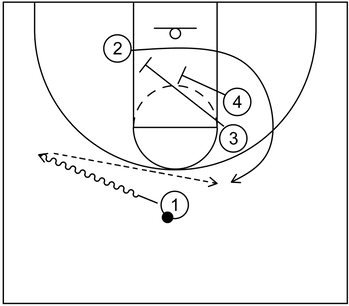
To begin the action, 1 dribbles toward the left side wing area. Next, 2 cuts across the lane to the right slot area behind the three-point line by way of the stagger screen set by 3 and 4.
From there, 1 passes the ball back towards the right slot, which is received by 2. Afterwards, 2 has an opportunity to take the open jump shot.
What is an example of stagger screen action within 1-4 high offense?
Within 1-4 high offense, a player could cut towards a perimeter area and receive the ball via a stagger screen, leading to a potential three-point shot.
A player could also backdoor cut prior to the stagger screen or receive possession of the ball via a post entry pass after the screening action happens.
The example diagrams below demonstrate this in more details.
The diagrams are also based on insights within Building the Perfect Offense by Geno Auriemma.
Part 1: Backdoor cut

To start, 1 enters the ball into the right side high post elbow, which is received by 4. Once that occurs, it is an automatic trigger for a backdoor cut from 2 who could receive the ball from 4 and score via a layup if that is open.
Otherwise, 2 simply continues the cut through to the left side low post area.
Part 2: Handoff and stagger

Next, 1 could cut towards the basket, receive a handoff from 4, and score at the rim. However, if 1 does not receive the handoff, then 1 could simply cut out towards the empty right side wing area.
Afterwards, 2 could cut to the left slot area by way of a stagger screen set by 3 and 5. From there, 2 could receive the ball from 4 and take the three-point shot if open.
Also, after setting the screen, 3 could fill the vacant low post area that was previously occupied by 2.
Part 3: Down screen

If 2 receives the ball but the three-point shot is not available, then 3 could cut to the left side wing area via the down screen set by 5. From that point, 3 could receive the ball from 2 and take the three-point jump shot if open.
Also, if 3 is not open for the shot, then 5 could establish position on the left side low post area, receive the ball from 3, and score via a low post move.
The post up action could especially be advantageous if the defensive team switches during the stagger screen action, which could result in defensive mismatches, particularly near the low post area.
What is an example of stagger screen action within 4 out 1 in offense?
Players in the slot areas could set a stagger screen following passing action towards a wing area. Afterwards, another player could utilize the screen and get open to receive the ball, leading to a possible three-point shot.
The example diagram below showcases this concept.
It should also be mentioned that the alignment shown is a wide 4 out 1 in featuring two players initially in the corners as opposed to the wing areas.

To start, 4 receives the ball from 1 and then 3 gets open with a v-cut to receive the ball from 4.
Next, 2 cuts to the top via the stagger screen set by 1 and 4. Afterwards, 2 receives the ball from 3 and takes the open three-point jump shot.
What are examples of stagger screen action within Horns offense?
Players could execute the stagger screen within Horns offense alongside additional actions such as a backdoor cut, curl cut, or slip screen.
The example diagrams below illustrate these points in more detail.
Horns stagger – Example 1
A player in possession of the ball could dribble towards the wing while high post players set a stagger screen away from the ball.
As another player uses the screen to get open, one of the screeners could slip to the basket and receive the ball, leading to a potential scoring opportunity around the basket.
Alternatively, that same screener could score via the low post area as well.

To begin, 1 dribbles toward the right side wing via the on-ball screen set by 5. Next, 2 cuts to the top via the stagger screen set by 4 and 5.
Immediately after that, 5 slips the screen and cuts to the basket while 4 pops to the left side corner. If 5 is open after the slip action, then 5 could receive the ball from 1 and score near the basket with a layup or dunk.
If 5 is not open, then 5 could cut towards the right side low post block, receive the ball from 1, and score via a low post move.
Horns stagger – Example 2
Two players could execute dribble handoff action while another player on the opposite side of the floor could reject a stagger screen and backdoor cut to the basket.

To start, 1 performs dribble handoff action alongside 2 near the left side wing. Afterwards, 1 fills the left side corner.
Following that, 3 would like to cut to the top via a stagger screen set by 4 and 5. However, X3 cheats the screen a bit and jams up the cutting pathway by standing in the gap between 3 and 5.
Therefore, 3 rejects the screen and counters with a backdoor cut to the rim, receives the ball from 2, and scores at the rim.
Horns stagger – Example 3
A player could utilize a stagger screen and curl cut to the basket, particularly as a counter to potential switch defense in this instance.

1 begins with a dribble entry towards the left side wing. Next, 3 cuts toward the top as X3 trails behind while fighting through the stagger screen of 4 and 5.
However, X4 lifts up to switch and take away the potential jump shot of 3. Therefore, 3 counters by executing a curl cut towards the basket. From there, 3 receives the ball from 1 and scores at the rim with a layup or dunk.
Why is the stagger screen potentially effective?
The stagger screen is potentially effective because it could lead to multiple scoring or playmaking opportunities.
As an example, the stagger screen is commonly used to create an open jump shot near the perimeter, particularly from three-point range for the team’s best shooter.
However, the offensive cutter that would initially try to get open for a jump shot could also reject the screen and cut to the basket.
This particular option could happen if the defender that is guarding the offensive cutter attempts to jam that same cutter by standing in the space between them and the screeners, especially if the stagger screen is in the form of a down screen.
Furthermore, the offensive cutter could possibly execute a curl cut towards the basket, particularly when the defender guarding them trails behind and one of the screener’s defender executes a defensive switch to take away the potential open jump shot near the perimeter.
Moreover, in certain instances, the offensive cutter that utilizes the stagger screen could receive the ball but instead of shooting it, that same player could dribble drive towards the basket, especially if the defender guarding them has to fight through the screen, which could result in a late defensive closeout.
That dribble penetration could then lead to a scoring option at the rim or a playmaking/scoring option beyond the three-point arc by way of basketball passing actions such as the kick pass or drift pass.
Also, one of the screeners involved in the stagger screen action could slip to the basket while the other screener pops to the perimeter. This, in turn, could result in more scoring options near the rim or near the perimeter as well.
In addition to that, after the stagger action, one of the screeners could set an on-ball screen for the player that received the ball or one of the screeners could set an off-ball screen for the other screener, which would be screen the screener action.
The stagger screen could also be implemented as false action and misdirection to primarily occupy the defense on one side of the court while the true offensive action occurs on the other side.
It should also be noted that if a perimeter player would be executing the stagger screen alongside a post player, then the post player should typically be the second screener.
The main reason for this is because it would be generally more difficult for the defensive team if they perform a switch after the second screen, especially if the screen cutter is a perimeter player as well.
For example, if the defender of the second screener is a post player and that same defender switches after the second screen occurs, then it would result in a defensive mismatch.
That is to say, an offensive perimeter player would be guarded by a post defender and at the same time, the offensive post player that set the second screen would be covered by a smaller defender as well.