What is a zipper cut in basketball?
The zipper cut comprises action that occurs when a player without possession of the ball cuts from the low post or corner area, generally through the lane, to the top, usually via a down screen, as a method of getting open to receive the ball.
What is an example of zipper cut action within Horns offense?
Within Horns offense, a player in possession of the ball could dribble towards a wing while a corner player performs the zipper cut to the top.
Afterwards, players could utilize high low action, a flare screen, a ball screen, and other actions to create various scoring opportunities.
The example diagrams below demonstrate these points with more details.
Part 1: Zipper Action
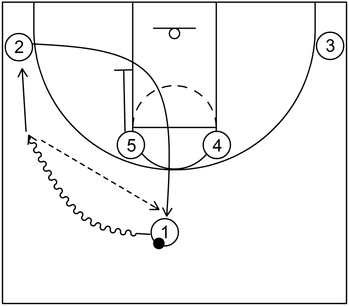
To begin, 1 executes a dribble entry towards the left side wing area and this also triggers 2 to execute a zipper cut to the top via the pin down screen set by 5.
After that, 2 receives the ball from 1 and then, 1 fills the vacated left side corner.
Part 2: High low and flare
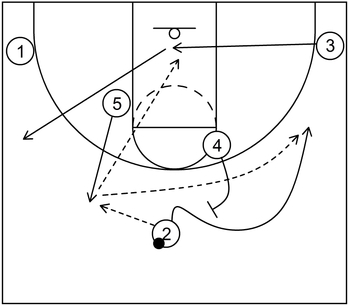
After setting the initial pin down screen, 5 pops out to the left slot area and receives the ball from 2. Immediately after 5 receives the ball, 3 cuts to the basket and hopefully seals the defender under the basket.
Once that occurs, 3 could possibly receive the ball from 5 via high low action and then quickly score around the basket.
If that option is not available, then 2 cuts toward the right side wing via the flare screen set by 4 while 3 cuts towards the left side wing area.
Next, 2 could take the three-point jump shot if that is open while 4 fills the right slot area.
Part 3: Side pick and stagger
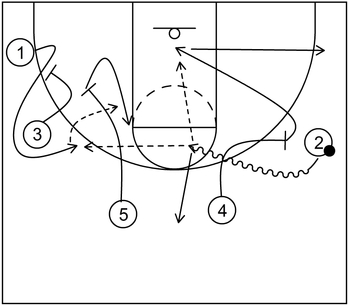
If 2 receives the ball but the jump shot is not available, then 2 could dribble towards the middle via the side pick set by 4.
As that happens, 1 cuts to the left side wing area via the stagger screen set by 3 and 5 while 4 rolls to the basket.
Next, 4 could receive the ball and score near the rim or 1 could receive it instead and take the open jump shot. Furthermore, 2 could also take the mid-range jump shot as well if that is open.
Additionally, if 1 receives the ball from 2 but the jump shot is not there, then 5 could cut back to the left side high post elbow and receive the ball from 1.
Also, in that instance, 4 could empty out to the right side corner for optimal spacing while 2 could cut to the top as a defensive safety.
Part 4: Handoff, kick out, or slip
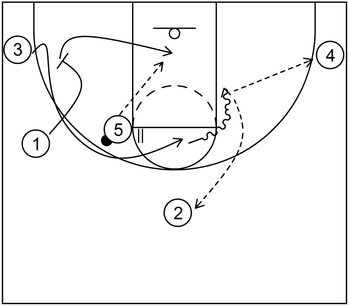
Next, 3 cuts toward 5 via a wide pin down screen set by 1 and receives the ball from 5 by way of a handoff. After that, 1 could try to get dribble penetration towards the basket and score at the rim or via a floater if necessary.
Additionally, 4 could receive the ball from 1 and take the open jump shot in the corner or 2 could receive the pitch back pass from 1 and take the jump shot as well if that is a viable option.
Also, as an alternative scoring option, when 5 is in possession of the ball, 1 could slip the screen and cut to the basket. Following that, 1 could receive the ball from 5 and score at the rim.
Affiliate Disclosure: I may earn a commission on qualifying purchases made through the link below.
Related: Loop and Elbow Offenses and Counter Sets – Cheryl Reeve
Why is the zipper cut potentially effective?
The zipper cut is potentially effective because it could be utilized primarily as an entry to implement additional offensive actions such as on-ball screens, off-ball screens, or isolation situations.
From that point, those supplementary actions could then lead to multiple scoring opportunities near the basket or near the perimeter.
As an example, let’s say that the offensive team’s best scorer, who also plays the shooting guard position, is in possession of the ball and that same player would like to utilize an on-ball screen, particularly at the top.
This could surely be achieved without the zipper cut but the problem is that the two defenders involved in that screening action (i.e. the scorer’s defender and the screener’s defender) would more than likely be prepared to defend against it, particularly with the defensive hedge tactic or the drop coverage tactic.
However, let’s say the offensive scorer utilizes the zipper cut followed by the on-ball screen. If that is the case, then that type of action is typically much more challenging to defend for both the scorer’s defender as well as the screener’s defender.
First, the scorer’s defender would have to avoid the initial down screen action to stay in front and not give up an open jump shot.
Second, even if the scorer’s defender successfully fights through the down screen, that same defender would also have to mitigate the effectiveness of the on-ball screen alongside the screener’s defender.
This could be quite an obstacle to overcome, at least with consistency, from both the scorer’s defender and the screener’s defender.