What is a drag screen in basketball?
A drag screen occurs when a player in possession of the basketball utilizes screening action, typically during secondary break of transition offense, before the defense is fully prepared and organized.
How to understand the player roles and diagrams on this page
In reference to any diagrams below, each of the offensive and defensive players are generally represented by the standard basketball positions, unless otherwise noted.
Additionally, offensive players are signified by numbers such as 1-5 while defensive players are indicated by the letter X, which is then followed by numbers such as X1-X5.
In essence, 1 and X1 indicate the respective offensive and defensive point guards. 2 and X2 signify the respective offensive and defensive shooting guards.
3 and X3 denote the respective offensive and defensive small forwards. 4 and X4 designate the respective offensive and defensive power forwards.
5 and X5 represent the respective offensive and defensive centers.
Moreover, in terms of a brief legend for the diagrams:
- Black Dot or Small Circle: The black dot or small circle represents the basketball.
- Solid Arrow: The solid arrow indicates movement or a cut on the basketball court.
- Dotted Arrow: The dotted arrow represents a basketball pass.
- Wavy Arrow: The wavy arrow indicates dribbling.
- T-Shaped Symbol: The T-shaped symbol signifies a screen, also known as a pick.
What is an example of drag screen and roll action?
A player could set a drag screen and then roll to the basket looking for a high percentage scoring opportunity.
The example diagram below demonstrates this concept.
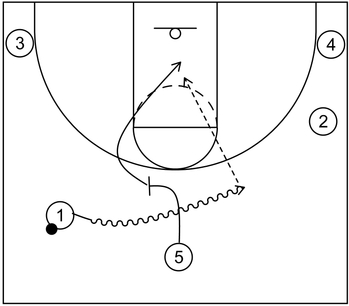
To begin, 1 dribbles towards the right side of the court via the drag screen set by 5 who also rolls to the basket. Next, 5 can receive the ball from 1 and score near the basket.
What is an example of drag screen and pop action?
A player could set the drag screen and pop to a perimeter area. Afterwards, that player could receive the ball and take a jump shot if open.
The example diagram below demonstrates this in more detail.
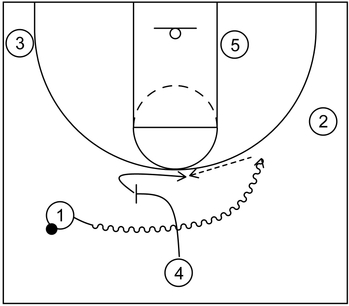
To start, 1 dribbles toward the right side of the court via the drag screen set by 4. Next, 4 pops to the top and receives possession of the ball from 1. After that, 4 can take the jump shot if open.
What is an example of a double drag screen with roll and pop action?
Two players can set a double drag screen and afterwards, one player could roll to the basket while the other pops to a perimeter area.
The example diagram below illustrates this point with more clarity.
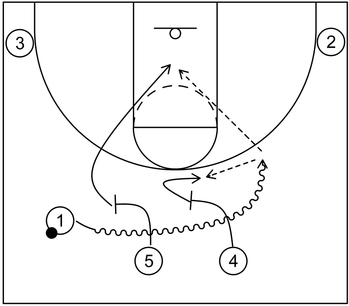
To begin, 1 dribbles toward the right side slot area via the double drag screens set by 4 and 5.
Next, 5 rolls to the basket while 4 pops to the top. 4 could receive the ball for a perimeter shot or 5 could receive the ball and score with a layup or dunk near the rim.
What is an example of a drag screen with stagger screen action?
A player can set a drag screen and while that occurs, two additional players can set a stagger screen, leading to a potential scoring opportunity.
The example diagram below showcases this concept.
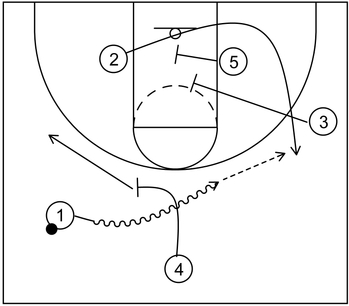
To start the action, 1 dribbles toward the top and as that happens, 2 cuts to the right side wing via the stagger screen set by 4 and 5. Next, 2 receives the ball from 1 and could take the open jump shot.
What is an example of a drag screen with elevator screen action?
A player could set a drag screen and while that happens, two additional players could set an elevator screen, which could result in a possible perimeter scoring opportunity.
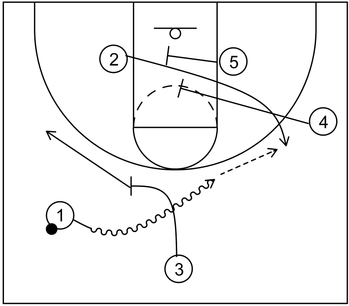
To start, 1 dribbles to the top via the drag screen set by 3 who also pops out to the left side wing.
Also, as that action happens, 2 cuts to the right side wing via an elevator screen set by 4 and 5. Following that, 2 could receive the ball from 1 and take the open jump shot.
What is an example of a drag screen with cross screen action?
A player could set a drag screen and while that occurs, another player could set a cross screen in the lane.
Furthermore, the player who set the cross screen could cut receive a down screen from the player who initially set the drag screen, which is also screen the screener action.
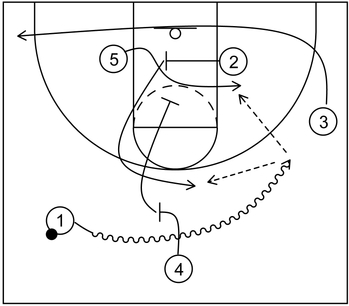
To begin the sequence, 1 dribbles to the right side wing via the drag screen set by 4. At the same time, 3 cuts through to the left side corner while 5 cuts to the right side low post via the cross screen set by 2.
Next, 2 cuts to the top via the down screen set by 4. From this point, 5 could receive the ball and score with a low post move or 2 could receive the ball and take the jump shot if open.
What is an example of a rejected drag screen with hammer action?
A player could reject a drag screen and attack the rim. While that happens, another player could drift to the corner via a hammer screen, receive the ball, and take an open three-point shot.
The example diagram below demonstrates this in more detail.
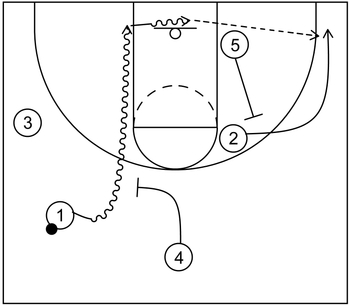
To start, 1 rejects the drag screen set by 4 and begins to dribble towards the basket.
At the same time, 2 cuts to the right side corner via the hammer screen set by 5. Next, 2 receives the ball from 1 and then takes the open three-point shot.
What is an example of drag screen twist action?
A player could use a drag screen that is initially set in one direction before utilizing a re-screen of that drag action in the opposite direction.
Moreover, while that occurs, another player could cut to the basket via an angled back screen, resulting in a potential high percentage scoring opportunity.
The example diagram below showcases this with more clarity.
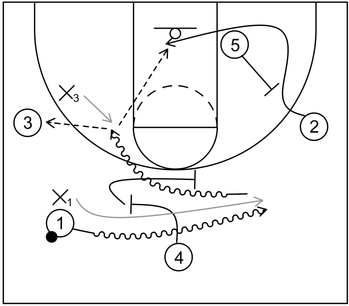
To start 1 dribbles toward the right side slot via the drag screen set by 4. However, X1 jumps over the top of the screen and is able to continue guarding 1, shown with the gray arrow.
When this happens, 1 dribbles towards the left side via a re-screen by 4, which could be considered drag screen twist action.
Additionally, as the re-screen action occurs, 2 cuts to the basket via an angled back screen set by 5. Next, 2 could receive the pass from 1 and score at the rim.
Also, 3 could receive the ball from 1 and take the potential jump shot if X3 executes poor defense while being only one pass away, represented by the gray arrow.
What is an example of a double drag screen with Spain pick and roll action?
A player could use a double drag screen set by two players. Afterwards, Spain action could happen, which would consists of a back screen being set for one of the screeners rolling to the basket.
The example diagram illustrates this in more detail.
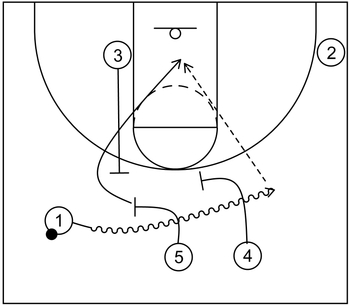
To start, 1 dribbles toward the right side slot. Also, as that happens, 5 rolls to the basket and receives a back screen from 3, completing the Spain pick and roll action.
After that, 5 could receive the ball from 1 and score near the rim.
What is an example of a drag screen within the numbered fast break?
A player could receive possession of the ball via an inbound pass in the backcourt while other players sprint to specific areas during a numbered fast break. From there, the player could dribble the ball into the frontcourt and utilize a drag screen, which could lead to a scoring opportunity near the basket.
The example diagram below illustrates this concept in more detail.
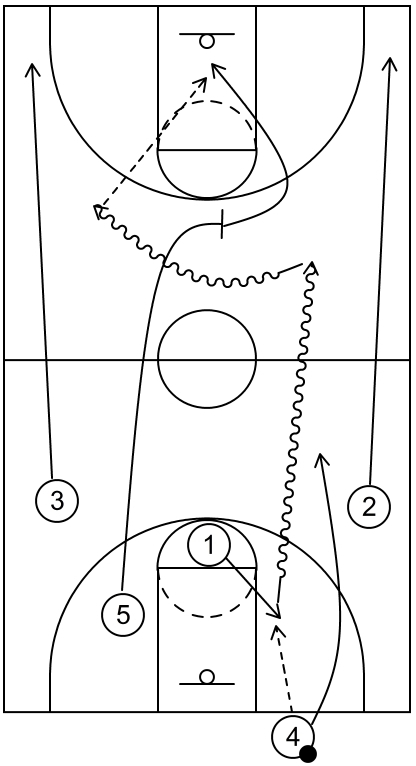
To start, 1 receives the inbound pass from 4 and as that happens, 2 and 3 begin cutting to the corners.
At the same time, 5 begins to cut towards the frontcourt near the top. Following that, 1 dribbles into the frontcourt and uses the drag screen set by 5. Afterwards, 5 rolls to the basket and can receive the ball from 1, leading to a potential layup or dunk.
Why is the drag screen potentially effective?
The drag screen is a potentially effective action because the defensive team will usually not be able to implement an adequate amount of ball screen coverage to limit or prevent its efficacy.
More specifically, during transition offense, the defensive team will generally try to protect the basket, stop the ball with immediate on-ball pressure, and/or guard against three-point shooters.
Yet, as that occurs, the defensive team is generally not well prepared to defend against the on-ball screen, which in this case, is the drag screen.
Essentially, in a standard half court setting in which the defense is fully set and organized, the defensive team will have the ability to counter against the on-ball screen, typically with tactics such as the defensive hedge, ice defense or drop coverage.
However, during transition defense, it is much more difficult to implement those types of defensive tactics, either at all, or at least sufficiently.